back to
Jack travel
|
Amsterdam-Stedelijk museum of
modern and contemporary art |
Leaving the Van Goghmuseum,
turn left down Paulus Potterstraat, to the STEDELIJK MUSEUM, whose bourgeois 19th
century (1892-1895) Neo-Renaissance exterior bellies belies in its adventurous
contents. It is my favourite museum in Amsterdam, however it is purely a
personal taste for art. I am a big fan and amateur of twentieth century art and
that’s what it is all about in this art shrine.
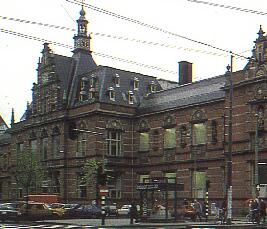 The Stedelijk museum is regarded as one of the leading museums of Modern Art and
its permanent collection includes works by Monet, Paul Cézanne (my favourite
post-impressionist, announcing cubism), Pablo Picasso, Bonnard, Dufy, Braque and
many others I will name later in this essay.
The Stedelijk museum is regarded as one of the leading museums of Modern Art and
its permanent collection includes works by Monet, Paul Cézanne (my favourite
post-impressionist, announcing cubism), Pablo Picasso, Bonnard, Dufy, Braque and
many others I will name later in this essay.
In fact it houses works from 1850
up. Its vocation is to reflect all international pictorial tendencies of the
moment. It’s a museum of “variable geometry” but impossible to describe
all you can find in these vast spaces, since more than 30 exhibitions are
organised every year. What is left of space houses the permanent collection? But
let’s describe it as if there was only an exhibition at the ground floor.
On entering the museum, climb the imposing marble staircase to the first floor,
where there is a rotating exhibition of works of the permanent collection. Among
them should be some of the museum’s lovely Cezanne landscapes, at least one of
the handful Van Gogh’s left behind when the Van Gogh collection moved to its
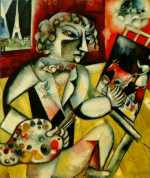
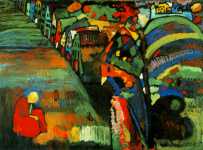
own museum, and works by Henri Matisse (1869-1964), Marc Chagall (1889-1985) and
Wassily Kandinsky (1866-1944). Pop art and action painting of the 1960s,
including Andy Warhol (1926-1987), Roy Liechtenstein and Jackson Pollock are
well represented, and the museum’s fine collection of work by living artists
is an eye-opener. Thus, contemporary artists are very well represented:
Rauschenberg, Barnett Newman, Kenneth Noland, Frank Stella and Edward Kienholz
with its “Beanery”, the bar in a container.
 |
 |
 |
 |
|
Chagall |
Kandinsky |
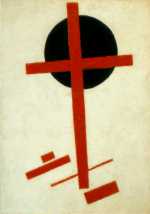
Malevich |
Mondriaan |
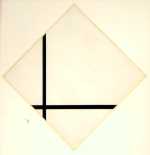
Top billing goes to the unique collection of works (the largest outside Russia),
by the Russian abstract painter Kazimir Malevitch (1878-1935) and by the Dutch
painters of the Stijl movement, Piet Mondriaan (1872-1944) and Theo van Doesburg
(1883-1931). Malevich and his Dutch contemporaries worked separately through WW
I and the Russian revolution, after which Malevich was unable to leave the
Soviet Union. But their work is very much along the same lines in its drive to
reduce art to the purely abstract means of solid geometric shapes.
The German expressionist school was not forgotten with unique works by Max
Beckman, Ludwig Kirchner and Karl-Schmidt-Rotluff. The Czech Kokoschka. Also
painters of the second half of the century have their place here: the
representatives of the “Cobra “movement, created in Brussels, like Karl
Appel, Armando, Jan Dibbets, Ger van Elk, Peter Struyken, Rob Scholte.
Walk downstairs to the Print room, whose startlingly eclectic, ever changing
collection includes the work of contemporary photographers.
Finally visit the ground floor. Here is obvious that the Stedelijk Museum
inherited something of the provocative attitude of the Dutch in the 60s. Here is
where the most innovative temporary exhibitions are held, many of them
calculated to send you on your way pondering the nature of art…..
Bibliography
Holland,
by Adam Hopkins (Faber and Faber, 1988), Penguin Guide to Amsterdam (ed.Vincent
Westzaan, Penguin 1990), Dwalen door Amsterdam en reizen door de Benelux, ( ed.
Lekturama 1984), “Amsterdam: The life of a city” by Geoffrey Cotterell
(Saxon house 1974), “20 ste eeuwse kunst in Amsterdam” by Karel Vervoort (Kunst
uitg-Amsterdam 1997)