|
BERGERAC is a
fine little city, seducing but living in a dolente rhythm, calm and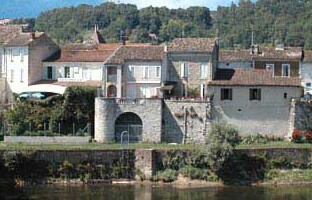 very provincial. . The swans swim in the Dordogne and a tidy cluster of
medieval, half-timbered houses bask by the old river port. It ha s also been
recently christened as the “capital of Purple Perigord”. The purple is of course
“pour le VIN: this is the only wine growing part, where 93 communes produce a
wide variety of vintages. Perhaps, in the days when Humphrey Bogart could seduce
Lauren Bacall by blowing smoke in her face, it would have been dubbed
Nicotine-Brown-Perigord.Tobacco is still a force to be reckoned with, and the
city is not only the home of the national institute du Tabac but also boasts a
unique museum on the maligned weed.
very provincial. . The swans swim in the Dordogne and a tidy cluster of
medieval, half-timbered houses bask by the old river port. It ha s also been
recently christened as the “capital of Purple Perigord”. The purple is of course
“pour le VIN: this is the only wine growing part, where 93 communes produce a
wide variety of vintages. Perhaps, in the days when Humphrey Bogart could seduce
Lauren Bacall by blowing smoke in her face, it would have been dubbed
Nicotine-Brown-Perigord.Tobacco is still a force to be reckoned with, and the
city is not only the home of the national institute du Tabac but also boasts a
unique museum on the maligned weed.
Medieval “Brageira”, or modern Bergerac, grew up around a feudal castle, but
really took off as town in the 12th with the construction of a bridge. As a
result the town became the chief crossroads on the Dordogne, and the town
evolved to a commercial centre and river port. Like most of France’s
self-reliant mercantile communities, it converted to Protestantism with gusto.
But this was also the reason of its decline: a slow death of Bergerac as a
prosperous commercial city. First the walls of the city were destroyed by
Richelieu in 1620; in 1681 dragoons forced Calvinists to convert to Catholicism;
in 1685 Louis XVI revoked the edict of Nantes, denying Protestants the right
worship. By the end of the 17th century, and estimated 40,000 inhabitants of
Bergerac and its surrounding land had emigrated to England or Holland. The city
only revived at the end of the 19th century thanks to tobacco, wine and the
national gunpowder works.
Start the
visit by strolling along the old port, castle was built in 1088. At the angle of
the rue du Port there is a tide meter, testifying the huge storms of the past.
The very narrow rue du Chateau has a house with an admirable gable end on the
roof, giving it the power to hoist merchandises into huge lofts.
Although Bergerac occupies both banks of the Dordogne, all the interesting
points for visitors are concentrated in the pedestrian area on the north bank.
Some of the fines buildings are in Place du Feu, a pretty square shaded by an
enormous old tree, and especially the handsome, turreted MAISON PEYAREDE (1604).
Now the National Tobacco museum? But that’s’ for the next article. |