|
The finest
buildings (14-17th century) for visitors in Bergerac are in Place du Feu,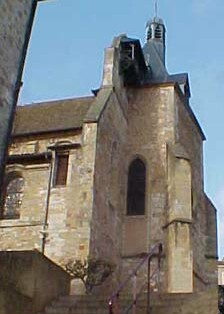 a pretty square shaded by an enormous old tree, especially the maison PEYAREDE,
now the NATIONAL TOBACCO MUSEUM. This museum is chockfull of curiosities on the
herb, beginning with documents showing that it was a sacred medicine of Aztec
gods and a binder of peace agreements among North American tribes (peace
pipe=calumet is one of the prize exhibits).Other items in the first room are you
can see how the slave ships brought it across the Atlantic to trade for their
human cargoes. An astonishing variety of African pipes is displayed like a bow
from the Cameroons that seems to be an intricately carved biography of the
smoker.
a pretty square shaded by an enormous old tree, especially the maison PEYAREDE,
now the NATIONAL TOBACCO MUSEUM. This museum is chockfull of curiosities on the
herb, beginning with documents showing that it was a sacred medicine of Aztec
gods and a binder of peace agreements among North American tribes (peace
pipe=calumet is one of the prize exhibits).Other items in the first room are you
can see how the slave ships brought it across the Atlantic to trade for their
human cargoes. An astonishing variety of African pipes is displayed like a bow
from the Cameroons that seems to be an intricately carved biography of the
smoker.
The upstairs room trace the use of tobacco in France from the late 16th until
the Revolution, when clay and porcelain pipes-later briarwood—became the rage.
There are paintings by Meissonnier and Teniers, but it was the 19th century
invention of the cigar and cigarette that awoke the masses to the delights (?)
of smoking. A display of cigar and cigarette holders and the rest of the museum
cover the history of Bergerac.
Behind the museum make a detour in the rue Saint-Clar with its gable ended
houses and come back to the museum through a superb patio. Take now the rue
d’Albret; pass the place du Feu and enter the Place du Docteur-Cayla to see the
CLOITRE DES RECOLLETS, a picturesque 16th century building with a wooden gallery
and lone tree. The Recollets were a Franciscan order founded in Spain, named,
according to the Catholic Dictionary, “from the detachment from creatures and a
recollection in God which the founders aimed at”. Louis XIII charged the
Recollets to bring the citizens of Bergerac back to the Catholic fold. After the
revocation of the Edit de Nantes, their methods of persuasion included
book-burnings. Today their cloister serves more congenially as the MAISON DES
VINS, headquarters of the regional wine-council.
Other city sights is the statue of CYRANO DE BERGERAC, who owes his tremendous
celebrity to Edmond Rostand’s successful 1897 play “Cyrano de Bergerac”; a
swashbuckling extrovert and poet with a very big and large nose. He was
appointed musketeer in a company of Gascons.
At the end of the Place de la Myrpe in Rue des Conférences is the MUSEE DE LA
BATELLERIE ET TONNELLERIE with an interesting collection of models and tools
used by vintners, coopers and boatmen in the days of yore.
The MUSEE D’ART SACRE occupies a 17th century Catholic mission and in the rue
des Fontaines you have two important buildings: the MAISON DOUBLET, where the
future Henri IV and the agents of Henri III negotiated a truce, and the 14th
century VIEILLE AUBERGE. |