|
back
to Bordeaux contents
|
Let's start our visit to
Bordeaux on or near the place de la Comedie.The tourist office is nearby and
if you are by car, there is plenty of parking place around the enormous
place des Quinconces, Europe's largest and one of its least interesting
squares.
But here, on the place de la Comédie, the ancient forum, a space that once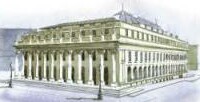 contained 300 houses, a church and a remarkable Gallo-Roman palace.
The Grand Theatre is built on the spot of this palace, which was torn down
at the order of Louis XIV. An opera house was built in 1773 and is
considered as one of the most beautiful of France. From the outside it
resembles a Greek temple, fronted by a row of mighty Corinthian columns and
crowned with statues of goddesses and muses. The auditorium (you can visit
the inside of the Grand Theatre), has golden columns and a domed ceiling,
hung with a massive chandelier weighing1350 KG. From the day it opened, this
high temple of illusion answered a deep felt need in business oriented
Bordeaux.
You can learn and taste the wide variety of wines at the Maison des Vins de
Bordeaux, on the corner of the place de la Comédie. The labels (Graves,
Cotes du Blaye….) are generic, but it's a good place to discover.
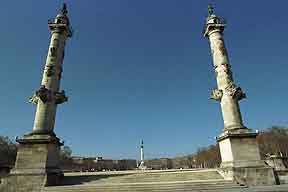 Just
down the cours du 30 Juillet rises the already mentioned place des
Quinconces. It's near the river and you should go and admire it for a
moment. At your right you will see the Pont de Pierre, sole bridge up to
1965, when the Pont Saint Jean (a little more to the right and in 1967, the
pont d'Aquitaine (at your left). Two columns,"les colonnes Rostrales"
erected in 1829, at the riverside, form the entrance to the Esplanade. You
can see the statues of Montaigne and Montesquieu. At the end of the
esplanade, the irrestibly overblown 19th century Monument aux Girondins, a
lofty column over a fountain mobbed by Happiness, Eloquence, Security, a
crowing cockerel and a host of other attractive allegories. This monument
was erected end 19th century in memoriam of the Girondins (inhabitants of
Bordeaux and its region), who died on the guillotine during the French
revolution in 1792. The column, 50 meters high, is crowned by Liberty,
breaking its chains. Just
down the cours du 30 Juillet rises the already mentioned place des
Quinconces. It's near the river and you should go and admire it for a
moment. At your right you will see the Pont de Pierre, sole bridge up to
1965, when the Pont Saint Jean (a little more to the right and in 1967, the
pont d'Aquitaine (at your left). Two columns,"les colonnes Rostrales"
erected in 1829, at the riverside, form the entrance to the Esplanade. You
can see the statues of Montaigne and Montesquieu. At the end of the
esplanade, the irrestibly overblown 19th century Monument aux Girondins, a
lofty column over a fountain mobbed by Happiness, Eloquence, Security, a
crowing cockerel and a host of other attractive allegories. This monument
was erected end 19th century in memoriam of the Girondins (inhabitants of
Bordeaux and its region), who died on the guillotine during the French
revolution in 1792. The column, 50 meters high, is crowned by Liberty,
breaking its chains.
The cours de Tournon, behind the monument, leads to the place Tourny, ,with
the statue of the "intendant de Guyenne", father of the 18th century
Bordeaux. Between the place Tourny and the place de la Comédie, you have the
beautiful "allées de Tourny", a promenade lined with linden trees, to give
the Bordelais a place to stroll.
Bibliography
Stephen Brook, Bordeaux, people, power and politics; Hubrecht Duijker,
Touring in Wine country 2000); Mel Packard, The Bordeaux journal.(2001)
|
back
to Jack Travel
|