|
From the porte Mordelaise, those 15th century rare remnants of the old walled city, follow the itinerary to the place du Calvaire. Just beyond is the RUE DU BASTARD, where a grand building turns out to be a monumental and beautiful Post Office (Palais du Commerce). The winding medieval streets give way to the carefully planned vistas and wide thoroughfares of later centuries. Anyway, most of the medieval side of Rennes is to find in the northern part.
Find the RUE ST.GEORGES and let's continue from there. This street is undoubtedly one of the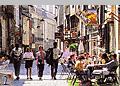 most typical medieval streets in Rennes, privileged because the big fire spared it. Pedestrian, bordered with cafés, it's one of the liveliest and its wooden houses and panels are a feast for the eyes. most typical medieval streets in Rennes, privileged because the big fire spared it. Pedestrian, bordered with cafés, it's one of the liveliest and its wooden houses and panels are a feast for the eyes.
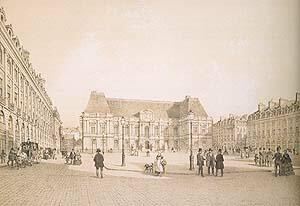
The following Place de La Mairie and place the Bretagne is in sharp contrast. This is what we call "precise planning". On the place du Palais (or Bretagne), the PARLEMENT de Bretagne is PALAIS DE JUSTICE today. The façade was designed by the Parisian architect Salomon de Brossé, (he built the Palais du Luxembourg) at the garden of the same name), and the inside decoration dates a bit later. Garlanded, gilded and painted ceilings. During your visit don't miss the biggest room:
 |
|
Parlement 1860 |
"LA GRANDE CHAMBRE DU PARLEMENT", a genuine masterpiece, where every square centimetre is decorated. Two big tapestries are notices: one represents the death of Du Guesclin; the other is a representation of the marriage of Anne de Bretagne to Charles VIII of France. Protruding into the chambers are raised loggias to allow ladies to follow events undisturbed.
Located in the northwest wing of the main floor of the parliament, the criminal court, the "CHAMBRE DU CONSEIL LA TOURNELLE" was decorated from 1665 on. After a series of different uses at the revolution it became the office of the first president in 1864. The coffered ceiling, the open fire and wainscoting are from Pierre Dumesnil and Francois Gillet, the ornamental paintings and gildings from Antoine de Brays. It is still in use.
Adjoining the Parlement, is the PLACE DE LA MAIRIE, designed by Jacques III Gabriel, another example of grand civic architecture: TOWN HALL. Its concave centre bell-tower is complemented by a convex theatre advancing opposite to it in the square. Town hall is open from 9.00 to 17.00. You can visit an old chapel, a large staircase with wall tapestries and the marriage hall.
The squares surrounding all these buildings come to life most spectacularly in the first 10 days of July each year, during the "street festivals of the TOMBEES DE LA NUIT". The originality of promoting Brittany's artistic creativity as well as that of other regions (including poetry, gastronomy, story-telling, theatre, traditional music and lyrical music) comes from the effort of integrating the festival totally within the city. Breton folklore, breton music. It is not uncommon to come across an Occitan duet playing in the Garden of Thabor, The artists who come to Brittany's capital, making it their theatre, have realized that the festival taking place here is a wonderful jumping off place for young artists who are in contact with 950,000 visitors each summer.
Bibliography
Les noms d'hommes et les noms de lieux', by Tanguy, B.(Association des amis des archives historique du Diocèse de Rennes.)- Aux Colours de Louisiane,by Klose, A.,Ouest France, Rennes France,1991
Contes et lâegendes de Bretagne : recueillis dans le pays de Rennes by Michel Lascaux -L'affaire du Parlement de Bretagne by Kozh Le Goarnig
A Breton Landscape , by Grenville Astill, Wendy Davies (1998)
|