|
The second
medieval square is the PLACE SAINTE-ANNE, towards the edge of the historical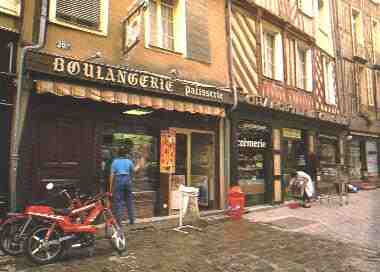 centre. Coloured, wooden panelled houses, gothic and renaissance. It is more
typical of French town squares, being given over to a tree-bordered car park
with good sidewalk cafes from which watch the world stroll by. At no.19 the
house of tailor Leperdit, who became mayor in 1794, hero of Rennes, during the
fanatic revolutionary times. He was one of the very most popular mayors of town.
centre. Coloured, wooden panelled houses, gothic and renaissance. It is more
typical of French town squares, being given over to a tree-bordered car park
with good sidewalk cafes from which watch the world stroll by. At no.19 the
house of tailor Leperdit, who became mayor in 1794, hero of Rennes, during the
fanatic revolutionary times. He was one of the very most popular mayors of town.
Other medieval merchants, to make their shop fronts stand out, adopted bright
decorations.
The best-spared medieval streets from the 1720 fire are the one, which radiate
from the place Sainte-Anne. Behind the facades, through bulging passageways and
low gateways, little courtyards open to show jetted staircases, wooden
balustrades and variations on sharply triangular slate roofs.
At the south, the RUE SAINT-MICHEL with its well-restored wooden panels, is
always full of restaurants, very animated, and has a lot of bars. Looked at
without the cafes and bars background it forms a beautiful architectonic
ensemble
To the north, rue Saint-Malo and, now slightly seedy, is also packed with
restaurants. It has a Spanish flavour and seems to specialize in fish. Most
famous is the “Ship-Shop” restaurant, which contrasts with its gaudy
yellow-beamed neighbour.
RUE ST. MELAINE specializes in creperie--though every street in Rennes seems to
have a handful—
 |
|
Entrance Thabor |
At the end of this street, the JARDINS DU THABOR, with its
botanic glass cases, geometrical designed flower beds and a great variety of
plants, overlooks much of the town, including the post-war
suburbs---uninspiring, treeless avenues of apartments. A 15th century
fresco remains in the church of Sainte-Melaine.
To the south of the place Sainte-Anne, take the short rue de Penhoêt. Along
this street, the “Brittany” is a well-known bookshop for students of Breton
culture.
Left off the rue de la Monnaie is the eye catching “MAISON DU GUESCLIN”, on
rue Saint-Guillaume, with its bulging medieval frame, slate covered side and
polychrome statues over the entrance.
At this point you have a choice: or you continue down to the eglise
Saint-Sauveur or track back to the rue de la Monnaie and proceed to the side
entrance of the CATHEDRALE ST.PIERRE.
Built on the vestiges of a gallo-roman temple, two churches were built in the
16th century and none of them exist anymore! It still has a colonnaded apse,
incense-filled on Sunday morning.
Just opposite the cathedral entrance is the PORTE MORDELAISE, a remnant of the
one imposing walls of the city. (is being continued)
Bibliography
Aux Colours de Louisiane,by Klose, A.,Ouest France, Rennes France,1991
Messageries Maritimes : paquebots et voyageurs du passé by Patarin, (P. Rennes : Editions Ouest-France, 1997.)
Contes et lâegendes de Bretagne : recueillis dans le pays de Rennes by Michel Lascaux
L'affaire du Parlement de Bretagne by Kozh Le Goarnig
A Breton Landscape , by Grenville Astill, Wendy Davies (1998)
|