|
One just needs to visit
and discover the Dordogne Valley to understand why the Périgord is also known
as the " Land of 1001 Châteaux ". Amid all these treasures is SARLAT,
City of Art, where the color of honey is added to each ray of sun through the
warmth of its stone buildings and is, without doubt, the gilt on the lily and
where a guided visit will enchant you. It is likely that many other towns in
France possessed as many curious and picturesque lanes, as many handsome
buildings, but modernisation gradually destroyed these treasures of the past,
and we can now rejoice that our city was miraculously saved thanks to a law
promulgated on the 4th of August 1962 (loi Malraux) by which the old town
received sufficient financial aid to undertake a programme of restoration, and
now the old facades are again as they were under their magnificent stone roofs
and the old quarters have been rescued from their lethargy by a lively and
lived-in town. Our architectural treasures are here for your admiration just as
the centuries have handed them down to us.
Said to have been inhabited since Gallo-Roman times, Sarlat became a prosperous
city at the end of the 8th century under Kings PEPIN LE BREF and CHARLEMAGNE
when Benedictines established a monastery there.
SARLAT had quite e tumultuous history, since Clovis, founded the first church at
what is now Sarlat.. Carolus Magnus stopped here to give it a fragment of the
true cross and some relics of certain Saint Sacerdos. An abbey was added in the
8th century and the village grew. It was nearly erazed from earth by the plague
in 1147 when Saint-Bernard made his visit and cured several victims with blessed
bread. After a century of struggle between the autocratic rule of the abbot and
the merchants, a truce “livre de paix” was signed. As compensation, pope
John XXII made Sarlat a bishopric in 1317, elevating the church to a cathedral.
The town suffered from the Norman invasions and then from the Hundred Years War
owing to its position as a frontier region between the kings of France and
England, The town, well fortified by its Consuls, withstood all attacks and only
became English at the end of the first part of the Hundred Years War (1360)
when, by the treaty of Brétigny, Edward III of England renounced his claim to
the throne of France in exchange for the South West of France. Ten years later,
the Connétable DU GUESCLIN chased the English from France and Sarlat re-became
French.
As a reward of its loyalty and despite all, Charles VII granted Sarlat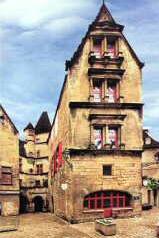 enough tax concessions in the 1441s to bring about its golden age and a building
boom. Nearly all of its hotel particuliers, or town houses, were built between
1450 and 1500, which gives Sarlat that rare architectural unity.
enough tax concessions in the 1441s to bring about its golden age and a building
boom. Nearly all of its hotel particuliers, or town houses, were built between
1450 and 1500, which gives Sarlat that rare architectural unity.
After the religious wars, Sarlat was a prosperous city throughout the XVI, XVII
and XVIII, but after that, too far removed from the main stream, like the
sleeping beauty, it fell into lethargy for nearly 150 years, to wake up again
only some thirty years ago when road transport supplanted river and railroad as
means of communication.
In 1827, the town fathers, trying to improve the passage, and decongesting
traffic, carved a long straight slice out of its heart to create rue de le
Republique, better known as the “traverse”.
Bibliography
Le Périgord (1991)de Jean-Luc Aubarbier,Contes et légendes du Périgord (8 avril 1999)-Sites préhistoriques en Périgord, de Jean-Luc Aubarbier (1996), A Taste of Perigord (mars 1994), from Helen Raimes-Dictionnaire des châteaux forts par G. Penaud),Voyage dans la France des troglos
par Saletat.
|