|
Back to Languedoc main page
|
I told you already but I repeat. The “cite” of
Carcassonne is the largest fortress of Europe and one of the main attractions in
France. In summer it is sometimes so crowded that you can count 3 persons per
square meter. And when it is hot…..no further comments.
The Cité is made car-free, but the hoards of tourists make up the miss of
gasoline and car madness. The most beautiful of Carcassone old city is not
inside but outside the walls. The castle and the cathedral also lay on the
outside against the walls. And one of the finest strolls is the promenade in the
space between the inner and outside walls.
In the inner wall there are still remains of the Roman wall: the Trencavels
built the present wall on top of it. The kings of France surrounded this old
wall with an outer wall, so the city gained moreless its present looks. The
architect Viollet-le-Duc had the order in 1844 to prepare for restorations.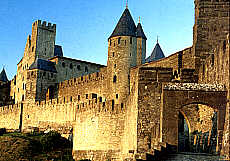 Later, the officials weren’t so happy with his work, since he gave grey pointed
roofs to the buildings like they use in the north of France. Only by pure
annoyance the southern roofs were given flat red appearances. Viollet-le-Duc neo
gothic version had great success elsewhere, like in Holland.
Later, the officials weren’t so happy with his work, since he gave grey pointed
roofs to the buildings like they use in the north of France. Only by pure
annoyance the southern roofs were given flat red appearances. Viollet-le-Duc neo
gothic version had great success elsewhere, like in Holland.
The gothic church Saint-Nazaire was the city church. The interior is adapted
neo-gothic. In the side chapels you can find a few medieval figures, like the
“Madonna de Rominguières” (13th and 14th).
The large CHATEAU COMTAL is part, since the enlargement by the French kings, of
the city walls, having been smaller and not attached to the walls before. The
present chateau was erected after many changes from the 11th to 14th
century. The museum that is houses is one of Roman and medieval sculpture. The
informative tour leads not much through the castle but outside the chateau, the
outer walls and along the theater.
The lower city of Carcassonne is not very exciting and ignored by the vast
majority of tourists. If you have some time, you can rest from the crowd and
excitement of the higher city: the cite. The streets follow a chess pattern,
because the city was built eat once and not progressively. You can compare the
lower city with Aigues Mortes, built in the same epoch. The small chapel NOTRE
DAME DE LA SANTE lays directly at the other side of the Aude near the 13th
century PONT VIEUX. The CATHEDRALE SAINT MICHEL is built shortly after the
lower city was done, but it is only a cathedral since 1803.Restored by Viollet
le Duc. The interior shows quite good what the people then imagined to be a
medieval interior. The EGLISE SAINT VINCENT has a high tower dominating the
city and the MUSEE DES BEAUX ARTS has a nice collection of Dutch and Flemish
paintings. |