|
Back to Languedoc main page
|
COLLIOURE is the most northern place of the rocky Cote
Vermeille; the inhabitants seem to be busy with tourists and …fishing. Despite
the word “picturesque” is used too many times by travel guides, this picturesque
port and light tower are indeed an ideal place for a painter like Matisse.
It is said that the Phoenicians already looked for protection behind the rocks
and that some local village existed already when they came: CAUCOLLIBERIS. In
1207 the Templars received a piece of ground as a reward and gift from Pedro II.
This was no charity, because it was the intention that the knights would defend
the coast against pirates seeking slaves. These were quite a plague in that
time.
The place returned successively to kingdom Mallorca, France, Spain and again
France.
Between the PORT D’AMONT and the PORT D’AVALL lay the remainders of the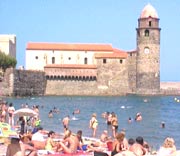 Templars castle. They are surrounded by the CHATEAU ROYAL. The chateau was built
by the ever reappearing Vauban. He was also the leader of the building works of
FORT MIRADOUX, north of Collioure, and the fort SAINTE-ELME.
Templars castle. They are surrounded by the CHATEAU ROYAL. The chateau was built
by the ever reappearing Vauban. He was also the leader of the building works of
FORT MIRADOUX, north of Collioure, and the fort SAINTE-ELME.
The church NOTRE-DAME-DES-ANGES replaced a church of the higher part of
Collioure that hindered Vauban in his plans. The church tower has a peculiar
form, thanks to the fact that it is a former light tower. Inside the church you
can find nine altar retables, the great altar (1698) is from Joseph Sunyer. The
same has made a lot of work on the altar of the Holy Sacrament. In the church
treasure there are some 15th century paintings.
All around is the VIEUX QUARTIER DU MOURE, an older quartet with pretty small
streets, cafes and shops. You can make a stroll from the church to the new light
tower. You will pass the Ilot Saint Vincent and its chapel.
The SENTIER DE LA MOULADE is a spectacular path that runs over the rocks to the
beach of ARGELES. Here and there it is widened with concrete. It starts at the
back side of Notre-Dame –des-Anges. |