|
Back to Languedoc main page
|
The 17th century HOTEL DE
SOLAS has gyps figures carved in the portal. The PREFECTURE, government of the
department, is located in a 148th century building. Remains of the Jewish old
Montpellier are thinly laid all over. Recently a “MIKVE”, Jewish ritual bath,
was discovered. You can only visit it with a guided tour (see tourist office).
At the place de la Canourque we have anointer series of small palaces: HOTTEL DE
RICHER, HOTEL DE BELLEVAL, HOTEL CAMBACERES-MURLES and HOTEL DU SARRET.
The 14th century church SAINT-PIERRE became a cathedral when the bishop’s seat
was transferred from Maguelone to Montpellier. The church is the only building
not destroyed during the religion wars.
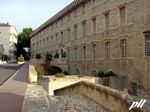
Next to the church is the FACULTE DES MEDECINES, situated in a 14th century
cloister very much restored in the 18th. It was one of the three faculties named
in the “bullet du Pape “ when he gave independence to Montpellier university in
1289. The atmosphere in Montpellier, in contrary of the
 one in Paris or
Toulouse, was opener and more free. It was one of the most important
universities in the middle ages and is still the most important in South France. one in Paris or
Toulouse, was opener and more free. It was one of the most important
universities in the middle ages and is still the most important in South France.
In the faculty building the MUSEE ATGER is also houses with one of the most
important collections of paintings by Italian and Flemish masters. The MUSEE
ANATOMIQUE shows people in different phases of conservation (prepared or
mummies) and a collection of sea shells.
At the other side of the boulevard Henri IV lays the JARDIN DES PLANTES, with
the intention to grow healing plants for the medical faculty. Henri IV built it
in 1593. It’s the oldest botanical garden of France.
Montpellier has only a few parks, but large enough to make an agreeable stroll.
The best one would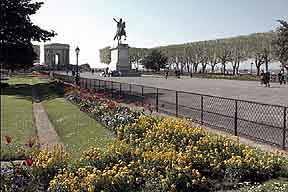 be the PROMENADE DU PEYROU, first built as framing for an equestrian statue of
Louis XIV and its arc de triomphe. It is said that the sculptor wanted to commit
suicide because he forgot to sculpt the stirrups. The statue you sea now dates
1838 and replaces the original which was destroyed during the Revolution. The
ARC DE TRIOMPHE reminds the glorious facts of the SUN KINGS career. Like the
laying of the Canal du Midi, the abrogation of the edit de Nantes and the
subduing of the Netherlands (1672), at that time its greatest enemy. The CHATEAU
D’EAU (1773) was the distribution key of water that was brought by an 880 meters
long Aqueduct Saint-Clement.
be the PROMENADE DU PEYROU, first built as framing for an equestrian statue of
Louis XIV and its arc de triomphe. It is said that the sculptor wanted to commit
suicide because he forgot to sculpt the stirrups. The statue you sea now dates
1838 and replaces the original which was destroyed during the Revolution. The
ARC DE TRIOMPHE reminds the glorious facts of the SUN KINGS career. Like the
laying of the Canal du Midi, the abrogation of the edit de Nantes and the
subduing of the Netherlands (1672), at that time its greatest enemy. The CHATEAU
D’EAU (1773) was the distribution key of water that was brought by an 880 meters
long Aqueduct Saint-Clement.
The water flew also from here to the fontaine des Trois Graces at the place de
la Comédie. |