|
Back to Languedoc main page
|
Left from the Passage de l’Ancre lays the Roman PALAIS
VIEUX (12th century), the old part of the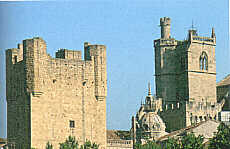 bishop’s palace. The inner yard, the COUR MADELEINE, is a pattern-card of
different building styles, from the Carolingian bell tower to the gothic and
renaissance windows of the palace.
bishop’s palace. The inner yard, the COUR MADELEINE, is a pattern-card of
different building styles, from the Carolingian bell tower to the gothic and
renaissance windows of the palace.
On the right you have first LA SALLE DU GROS PILIER (14th century),
this room, built in an irregular way, used to be the kitchen of the palace. Now
it houses an interesting collection of medieval sculptures. The oldest are from
the time of the Visigoths. Some further in the passage is the way through to the
inner courtyard of the PALAIS NEUF. Here you have a magnificent view if you
a re on the DUNGEON GILLES AYCELIN. The dungeon was built in the 12th
century on Gallo-roman fundaments. The SALLE DES SYNODES was the conference hall
of the States of Languedoc. Seventeen beautiful tapestries hang all over the
walls. More in the Palais Neuf: the MUSEE ARCHEOLOGIQUE and the MUSEE D’ART ET
D’HISTOIRE. The first houses the local archeological findings from prehistory
and antiquity, the second has, among others, a collection of French and Italian
paintings.
Not far from all this lays the HORREUM. This is a roman warehouse and the only
building that remains from Roman Norborne. The rests which were dug up are now a
museum.
A little bit further is the basilique SAINT-PAUL-SERGE. Like it happened more
often, it was built on the spot where there used to be a Roman cemetery, to
honor a Christian martyr. The Saint-Paul-Serge is built on the grace of the
first bishop of Narbonne. The high choir dates 1229. The church interior has
wall tapestries from Aubusson, a few organs and altar retables. Under the church
is an old Christian crypt, on the spot of the Roman burial place. One of the
Christian sarcophagus you see there are said to be one of the oldest in France.
Other medieval churches are the SAINT-SEBASTIEN (15th century), built
on the birthplace of that saint, and NOTRE-DAME DE MOURGUIE. This church has the
MUSEE LAPIDAIRE. Roman busts sarcophagi, architectural fragments, and
commemorative columns. If you are a specialist in Latin inscriptions, here you
have work for a few months.
Along the CANAL DE LA ROBINE, an embranchment of the Aude, it is nice to make a
stroll. There are even paying watertours.
To enhance the image of the city, the municipality has put some pieces and part
of Roman pillars all over the city. The PLACE BISTAN lays on the place of the
Roman forum. With wall pillars and painted walls, they tried to reshape the
atmosphere of the medieval era.
Fourteen km southwest of Narbonne lays the ABBAYE DE FONTFROIDE, an attraction
of quietness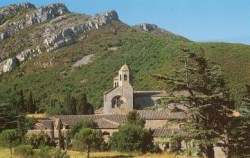 and
peace. Try the first or the last tour and don’t go in full season. This
Cistercian abbey was founded in the 12th century. Every building
style from that time until the French Revolution is to find on the construction.
After that the cloister buildings came into private hands, fell into decay and
finally were restored. A few prominent ecclesiastics coming out of Fontfroide:
Pierre Castelnau, the pope legate whose dead was the reason of the Cathar
crusade and Jacques Fournier, the bishop whose reports of trials against Cathars
would be the foundation of the book”MONTAILLOU” and who became pope Benedictus
XII. After the plague epidemics of 1348 the decay struck. From 1476 the
Fontfroide abbey had an abbey “in commendam”. This meant that a non
ecclesiastical could be an abbot and had the right on the benefits of the abbey.
For these abbots the cloister was a luxurious home. and
peace. Try the first or the last tour and don’t go in full season. This
Cistercian abbey was founded in the 12th century. Every building
style from that time until the French Revolution is to find on the construction.
After that the cloister buildings came into private hands, fell into decay and
finally were restored. A few prominent ecclesiastics coming out of Fontfroide:
Pierre Castelnau, the pope legate whose dead was the reason of the Cathar
crusade and Jacques Fournier, the bishop whose reports of trials against Cathars
would be the foundation of the book”MONTAILLOU” and who became pope Benedictus
XII. After the plague epidemics of 1348 the decay struck. From 1476 the
Fontfroide abbey had an abbey “in commendam”. This meant that a non
ecclesiastical could be an abbot and had the right on the benefits of the abbey.
For these abbots the cloister was a luxurious home. |