|
Back to Languedoc main page
|
“Narbonne, carrefour du Sud” is to read in giant letters
over the autostrade when you arrive in Narbonne. Something in it is true. It
is an important autostrade knot and in any case Narbonne has busy train traffic.
And because a great deal of the railway traffic to Catalunya passes along
Narbonne, we can say that the railway is one of the largest providers in work
here. But despite the good connections it are the other cities in the area which
are well off and not Narbonne. Nevertheless the wine industry and tourism helps
the economy, but the high tech has settled down in Montpellier and Perpignan.
The city is with its 50,000 citizens the largest city in the department but even
not the capital which is Carcassonne where political decisions are made.
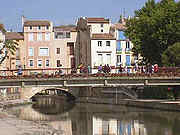
A bit disturbed by its ranking of fifth wheel, it could seem Narbonne agreed to
it. Nothing is less true. The municipality has recognized the great potential by
renovations its’ old parts and that attracts people. Panels are everywhere,
which send you fro attraction to attraction.
Now let’s have some history. The Roman COLONIA NARBO MARTIUS was de largest city
in the Roman province which was named after it: GALLIA NARBOSENSIS. Founded in
118 B.C., next to a Celtic fortified place, a first roman colony outside Italy.
Thanks to the location along the commercial route from Italy and Spain, and
because of the harbor, the city bloomed. But very large ships could not come
into the city, that’s why the good were transferred to lighter boats in the sea
harbor. In the 3rd century, Narbo was walled new, because of the
increasing insecurity in the imperium. The city—like the Roman Empire—was passed
its peak and after the collapse of the imperium, Narbonne fell to Wisigoths,
Saracanes and Francs.
The medieval history of Narbonne is enlivened by the heavy conflicts between the
archbishop, the count and later the bourgeoisie, lead by the consuls. The court
of Countess Ermengarde de Narbonne was famous as hospitable spot for
troubadours. At the end of the 14th century, Narbonne’s wealth went
backwards because of the 10-year war and the silting up of the harbor. After the
Treaty of the Pyrenées (1659) the garrison soldiers left, Narbonne was no longer
a border town. It became a city of churches and cloisters
In the 19th century the city took advantage of the railway and the
revival of the wine industry. The phyloxera-eruption from 1875 and the uprising
of 1905 put and end to it. |