|
Back to Languedoc main page
|
In the middle of Narbonne lays the cathedral complex and
the archbishop palace. There is so much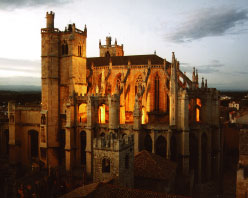 to see here that even well trained art lovers will have it difficult! That’s why
I do a total random in my choice to present you. The terse CATHEDRALE SAINT JUST
was never finished. The choir was closed with a wall, the nave and transept you
have to imagine. But it is impressive after all. The vault and dome is one of
the highest in France (41m). Building began in 1272, almost at the same time as
the cathedrals of Toulouse and Rodez and shortly after the county of Toulouse
(and herewith Narbonne) was added to the French kingdom. The architect was Jean
Deschamps, who designed also the cathedrals of Toulouse and Capestang. If the
cathedral was to be finished, they would have to destroy a bastion. But because
the times were restless and the population didn’t want to start with that plan.
So the building was stopped in 1340. The population was right after all: in 1355
the English army appeared in front of the city, led by the Black Prince. Thanks
to the bastion next to the cathedral, the city could hold its positions.
to see here that even well trained art lovers will have it difficult! That’s why
I do a total random in my choice to present you. The terse CATHEDRALE SAINT JUST
was never finished. The choir was closed with a wall, the nave and transept you
have to imagine. But it is impressive after all. The vault and dome is one of
the highest in France (41m). Building began in 1272, almost at the same time as
the cathedrals of Toulouse and Rodez and shortly after the county of Toulouse
(and herewith Narbonne) was added to the French kingdom. The architect was Jean
Deschamps, who designed also the cathedrals of Toulouse and Capestang. If the
cathedral was to be finished, they would have to destroy a bastion. But because
the times were restless and the population didn’t want to start with that plan.
So the building was stopped in 1340. The population was right after all: in 1355
the English army appeared in front of the city, led by the Black Prince. Thanks
to the bastion next to the cathedral, the city could hold its positions.
The cathedral has a lot of art treasures. Like in the side chapels an alabaster
Madonna (ca.1400), a polychrome stone sepulture (Bavaria15th
century), a few sculpted graves (15-17th century) of city notables,
the organ dates 1741. The main altar (1692) is designed by J.HARDOUIN-MANSART,
the architect of the Dome des Invalides in Paris and the Galerie des Glaces in
Versailles. On the pillars newt to the altar a few medieval painted ones. Via
the chapel SAINT-MICHAEL you arrive at the CHAPELLE DE L’ANNONCIADE (15th
century). The upper hall is constructed in such a way that if you talk softly,
your words can be heard at the other side. It is said it was used as confession
space for the leprous. Here is the showcase of the wealthy church treasure:
medieval manuscripts, a superb Brussels tapestry (15th century)
representing the “creation of the world” and an ivory plaquette from the 10th
century.
Next to the cathedral there is a gothic cloister (end 14th century)
with striking gargoyles. The cloister was a reward because they couldn’t
continue to build the cathedral and that the bastion stayed where it was.
In the southern wall of the cloister is a door leading to the PASSAGE DE L’ANCRE.
Named like that because of the anchor that hangs there in reminder of the rights
of the bishop into coastal navigation. |