|
Back to Languedoc main page
|
Nemausus was built like all other by Roman founded
cities. A straight forward main street, the “cardo”, crossed with a square
crossing the other main street, the “decumanus”. All other streets were parallel
to one of these two. On the crossing of the cardo and the decumanus was the
forum, with the most important temple and buildings of government. The ideal
city was with a square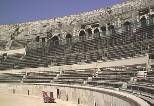 angel, but the terrain was not always good for it. Nemausus has an irregular
form because of the hills where it laid. The Roman amphitheater was usually
situated very near to the city walls.
angel, but the terrain was not always good for it. Nemausus has an irregular
form because of the hills where it laid. The Roman amphitheater was usually
situated very near to the city walls.
Also with our amphitheatre in Nimes called “LES ARENES”, the case was the same.
The archeologists don’t know exactly when it was built, first or second century
after Christ or even earlier. The one who stands inside the enormous vat will
have great difficulty to imagine there were thirteen other amphitheatres in the
Roman Empire bigger than this one! The one of Nemausus measured 133 on 100
meters and could house 23,000 spectators. Thanks to the thoughtful system of
stairs and corridors, it was no sweat to get the people in a few minutes outside
on the street.
Despite it had to endure a lot, this amphitheatre is one of the best conserved.
The Visigoth turned it into a fort. The Trencavels, counts of Nimes and also of
Carcassonne, used a part as a castle. Later they built a small city quarter in
the building, with two chapels. Seven hundred people lived inside at its most
glorious moments. In the 19th century, the houses were removed and
the arena restored. The arena is not only a touristy attraction, it is in the
middle of Nimes’ city life. The bull fights you can see during the fiesta are
the highlight of the event, like the gladiators and wild animals were for the
Romans.
The HOTEL DE BERNIS is only one of many city palaces, enhancing the streets of
the old city. It is worth, when you stroll through the alleys and small winding
streets, to look straight up to the houses. The rue d’Aspic has also nice
houses. In the inner courtyard of no.8 is a Renaissance staircase. A token of
the wealth of archeological remains are the early Christian coffins laid in
bricks in the wall. The PASSAGE DES MARCHANDS starts just next to (cross the
street). It runs half under half between the houses. It is a good example of the
renovation of the old city. At and around the passage are also nice shops. |