|
Back to Languedoc main page
|
The JARDIN DE LA FONTAINE was built in the 18th
century as framing for the rests of the Roman sources sanctuary, designed by
architect Marechal. Usually his specialty was building fortresses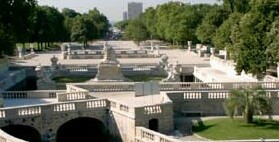 but he made
pretty a good job with the gardens.This garden id the oldest public garden in
France. One, who loiters between the classistic grandeur of the sculptures and
balustrades, thinks with nostalgia at good old Roman times. It�s a spot where
the Nimois like to come, to play boules, drink coffee and lye and the grass. On
the left between the trees lays the ruin of the so-called TEMPLE DE DIANE. This
building was NOT dedicated to Diana and was not even a temple. The question,
what was it then? leads us archeologists (a title I invented for myself;-)) to
some confusion and the best thing too do is to fantasize about. It is assumed
it dates from the 2nd century because it looks like the Asiatic
temple of that time. The temple was located at the decumanus and indirectly at
the Via Domitia. Passing merchants could offer here quickly some sacrifice
before getting of to Spain. but he made
pretty a good job with the gardens.This garden id the oldest public garden in
France. One, who loiters between the classistic grandeur of the sculptures and
balustrades, thinks with nostalgia at good old Roman times. It�s a spot where
the Nimois like to come, to play boules, drink coffee and lye and the grass. On
the left between the trees lays the ruin of the so-called TEMPLE DE DIANE. This
building was NOT dedicated to Diana and was not even a temple. The question,
what was it then? leads us archeologists (a title I invented for myself;-)) to
some confusion and the best thing too do is to fantasize about. It is assumed
it dates from the 2nd century because it looks like the Asiatic
temple of that time. The temple was located at the decumanus and indirectly at
the Via Domitia. Passing merchants could offer here quickly some sacrifice
before getting of to Spain.
The park also is a part of the MONT CAVALIER. Up on this hill you have the TOUR
MAGNE, the TURRIS MAGNE, and (large tower), in the city walls that Augustus had
ordered to build around Nimes. What is that tower? Standing on the fundaments of
an old Gallic tower, it is too easy to say that it is juts a tower because the
size and special eight angular form. It was certainly a monument or a watch
tower. One had seen him also as a sort a sacred place or copy of the light tower
of Alexandria---this especially since Egyptian veterans had lived in Nimes. Up
above in the tower you have a stunning view on Nimes.
If you are interested in archeology, you can visit the CASTELLUM DIVISORUM. This
was not an army camp but the water distribution station of Nimes. The water was
brought in via de PONT DU GARD from the hills near Uzes, and entered the city
here. Above the castellum lies the CITADEL, ordered by Richelieu to keep the
Protestants down and calm. The FONTAINE DE PRADIER dates 19th
century, in the park near the amphitheatre. The fountain is now named with the
name of the sculptor, but the female figure on top symbolizes the city. Pradiers
girl friend, Juliette Drouette, was the model. Later she became the maitresse of
Victor Hugo. The BUS STOP of PHILIPPE STARK is a little further. Its one of the
sculptures that has been put the last years in Nimes. It is said that the real
name is SIGNAL URBAIN but there is no chance it will be called that name as long
as buses stop next to the monument.
The MUSEE DU VIEUX NIMES, next to the cathedral, contains all forms of
applicated art: nice regional regional
cupboards, beautiful textures and a few old machines.
The MUSEE D�ARCHEOLOGIE keeps of course a lot of Roman material (images,
inscriptions, glass), but also prehistoric, Greek and Etruscan ceramics. It is
housed in an old Jesuit cloister. Adjacent is the CHAPELLE DES JESUITES,
considered as the most beautiful of Nimes. Finally the cloister has also the
MUSEE D�HISTOIRE NATURELLE. Here you cannot view only dead animals but also
cultural expressions from Asia, Africa and the South seas. The MUSEE DES BEAUX
ARTS has a great collection of French, Italian, Flemish and Dutch paintings. The
top piece is a large Roman mosaic: THE MARRIAGE OF ADMETUS.
Round city center lay a series of 19th century churches: the EGLISE
STE PERPETUE, THE EGLISE SAINTE BAUDILE, the EGLISE SAINT CHARLES and the EGLISE
SAINT PAUL. |