|
Back to Languedoc main page
|
BEZIERS is the capital of wine and rugby, the things the
Languedociens find important! Life in the city is principally busy in the
triangle between the cathedral and the ALLEES PAUL RIQUET. Beziers is also a
good departure point to explore the surroundings by public transportation.
Trains departure in all directions, also the hinterland. Same for the buses,
leaving place Jean-Jaures (near the alleés).
Beziers was founded as a Celtic settlement on a hill, dominating a fordable spot
of the river. Since then, everybody who played rules in Beziers recognized the
importance and strategic position of this spot. The Romans changed the Gallic
OPPIDUM slowly into a Gallo-Roman, or even better, Romo-Gallic city and even the
passing barbarous couldn’t take over Beziers after the fall of the Roman Empire.
When the French army passed through Languedoc in 1209, in their crusade against
the Cathars, it was inevitable that the city would be besieged and taken. The
“crusaders e decided to make an “example”. The whole city, including women and
children, was to be exterminated, murdered. The fact that there was a part of
the people being faithful to the king and Roman Catholic didn’t count! Even
those who have sought refuge and asylum in churches were slaughtered. “ They
kill anybody who crosses their path. Altar, neither cross nor crucifix is a
refuge. The murder priests, the mad scoundrels, and women and children….God
shall receive the souls, if it pleases him, in paradise”, wrote a poet who was,
by the way, pro-crusader. The massacre took 20,000 victims and even for the
Middle Ages that is a lot.
It took a long time before Beziers stood against up after this blow. The
construction of the Canal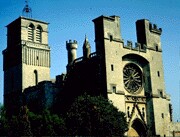 du Midi in the 17th century, and the renewal of the wine industry in
the 19th century, were very important for the revival of the city.
du Midi in the 17th century, and the renewal of the wine industry in
the 19th century, were very important for the revival of the city.
In the oldest part of Beziers lays the Gothic SAINT NAZAIRE, cathedral until the
abolition of the Bishopric of Beziers in 1789. The church is built on the ashes
of a Roman predecessor who got destroyed with the siege of 1209. Inside you can
see a 16th century figure of Christ, an altar from 1758 and a few
Roman capitals near the choir. The organ (1623) is exalted by a baroque
sculpture. The CHAPELLE DE LA VIERGE dates 13and 14th century. |