|
Back to Languedoc main page
|
Next to the cathedral lays the bishop’s Palace. Via the
14th cloister corridor from the 14th century you arrive
small garden in the palace. From this belvedere you have a fine view on the
river Orb. , with the medieval PONT-NEUF. Like his brother in Paris, is this
bridge the oldest of the town. Further on, the canal du Midi draws a sketch in a
double array of trees.
Behind the church lays an area with a lot of winding streets and a lot of
neglected houses, some are even medieval. On and around the place DES BONS-AMICS
you will find some terraces and restaurants. The MUSEE DES BEAUX-ARTS is divided
over the Hotel de Fabregat and the Hotel de Fayet. Next to paintings from the
Flemish and Italian school there are works of Gericault, Utrillo, Chirico,
Delacroix and Dufy. The sculptures are stuffed between the paintings! That’s the
eternal problem: no space enough! The museum holds also drawings of Jean Moulin.
This French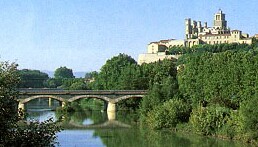 resistance hero was born in Beziers and he was the best known of the victims of
war criminal Klaus Barbie, condemned in Lyon a few years ago. The MUSEE DU VIEUX
BITERROIS ET DU VIN is, as the same supposes, a museum about wine and the
history of Bezier sans surroundings. The HOTEL DE VILLE dates 18th
century. Just next to the place PEPEZUC, a worn out Roman figure, that is called
with love and care PEPEZUC by the Bitterois (citizens of Beziers). It stands
there since the Middle Ages. Pepezuc is named after a Montpezuc, a commander who
defended the city against the English.
resistance hero was born in Beziers and he was the best known of the victims of
war criminal Klaus Barbie, condemned in Lyon a few years ago. The MUSEE DU VIEUX
BITERROIS ET DU VIN is, as the same supposes, a museum about wine and the
history of Bezier sans surroundings. The HOTEL DE VILLE dates 18th
century. Just next to the place PEPEZUC, a worn out Roman figure, that is called
with love and care PEPEZUC by the Bitterois (citizens of Beziers). It stands
there since the Middle Ages. Pepezuc is named after a Montpezuc, a commander who
defended the city against the English.
After the city walls were torn down in the 19th century, they could
start building the ALLEES PAUL RIQUET. They are named after the designer of the
CANAL DU MIDI that used to be called CANAL-entre-DEUX-MERS. Its statue (David
Angers, 19th century) stands next to the bus station. The Allées are
Beziers' version of a crossing between the Spanish Ramblas and the Champs
Elysées. You have there the great department stores, the theater, strolling
alleys, boulodromes where boule is played and on Fridays a flower market. The
park at the end of the Allées is designed by Bulher, who also designed the Bois
de Boulogne in Paris.
Excepting the Saint-Nazaire there are other interesting medieval churches in
Beziers. The BASILIQUE SAINT-APHRODISE was the cathedral of the city up to 760.
The church is dedicated to the first bishop in City. In the wall around the
entrance from the 14th century church, pieces of Roman sarcophagi are
immured. At the other side of the square hangs a plaque reminding the legend of
St.Aphrodise. He is supposed to have brought a camel when he fled Egypt. So,
every year in the cities procession of their saint (April) a camel is always
present.
The Partly Roman, partly gothic SAINTE-MADELEINE is being restored as I write
this lines and I hope the works will soon be finished. This was the place where
most dead occurred in 1209, the church was arsoned while a great deal of the
population was inside.
At the other side of the Orb, 1.5 km outside the centre, lay the ECLUSES DE
FONSERANNES. This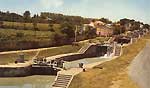 series of 9 locks makes it that the Canal du Midi can come down or up 21 meters.
Eleven km south of Beziers, in an almost Dutch countryside with lots of water,
lays SERIGNAN. Cathars who returned to Catholicism could be set on pilgrimage
all over a lot of churches. The distance corresponded nicely like the Tour de
France today. About 2170 KM. One of the churches was the church in Serignan.
This gothic building (12th-14th century) stands on a Roman
blue print and has, like many churches in the neighborhood, castle elements. The
nicest piece of the church is an ivory crucifix that is said chiseled by
Benvenuto Cellini. This cross is hidden in a deep niche left from the choir.
Passed Serignan, along the coast, is VALRAS-PLAGE, the bathing resort of Beziers,
once a fisher’s village. The pink condominiums are not too showy but the most
fun is ate the yacht harbor. Part of the large beach is reserved for nudists. |