Amboise Clos Luce Leonardo da Vinci Site Home - What's New? -Feedback - About Jack- Travel/Art Links

Loire Valley
|
Amboise Clos Luce Leonardo da Vinci Site Home - What's New? -Feedback - About Jack- Travel/Art Links |
|
|
|
Loire Valley |
|
Amboise-Clos Lucé and pagoda of Chanteloup |
|||||
|
Clos Lucé and Chanteloup
|
|
||||
|
Ascend the rue Victor-Hugo
coming from the chateau. 400 meters and you are at
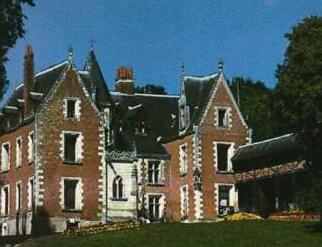
When Leonardo da Vinci arrivedin 1516, he brought with him, on the back of hiss donkey, three of his paintings. The Mona Lisa, Sainte-Anne and John the Baptist. In the castle a painting shows Leonardo selling his Mona Lisa to François 1er. It is said that Francois 1er came to Clos-Lucé through a secret tunnel from the chateau.
The Clos-Lucé was entirely
at the disposition of Da Vinci thanks to this art-loving king. He could work,
feast, and live without any financial problem. Once you penetrate in the interior courtyard, you realize that everything
here is made for "the pleasure of the eyes".. A 16th century oratory,
added at the demand of Anne de Bretagne, is decorated by frescoes executed under
the supervision of the master Leonard. Notice the splendid drape of the Virgin
in the Annunciation and the wing movements of the angel. The whole art of Da
Vinci is resumed in this room. The frescoes have been very well restored, since
incompetent ignorants coated them in the 19th century. In Clos-Lucé you can not
only breath the atmosphere of old times but look at a beautiful collection of
small rough models scale projects of A little tour in the
neighbourhood of Amboise (follow the directions from the hotel de ville) brings
us 3 km south to the PAGODE DE CHANTELOUP Bibliography Regions Gourmandes: Les pays de la Loire, by H.Walden (Paris, ed.Hatier 1993)—Guide du Patrimoine, Centre, Val de Loire , by Perouse de Montclos (ed.Hachette 1992)—Het dal van de Loire, by A.Sperber (Brussels, ed.Harenberg 1992)—Par les champs et par les greves, by G.Flaubert (1885)—Guide du Routard 1998 (ed.Hachette)—de kastelen van Frankrijk, by L.P.Boon (1956)-Leonardo da Vinci en France, by J.de la Touraine (ed. Seuil 1987), Les rois a Amboise, by Paul Touvry (ed.Castellin, Tours 1978) |
|||||
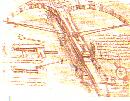
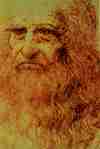 Leonardo da Vinci like a parachute, a
helicopter and revolving bridge (realized by I.B.M. (following Da Vinci's
sketches). The artist lived his last years at the manoir du Clos-Luce and died
there in 1519.
Leonardo da Vinci like a parachute, a
helicopter and revolving bridge (realized by I.B.M. (following Da Vinci's
sketches). The artist lived his last years at the manoir du Clos-Luce and died
there in 1519.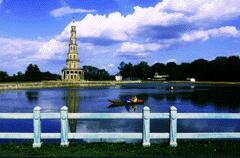 (1775). 44 meters high, its loony
style reminds how much the 18th century liked the "Chinese look".
That's all what's left from a splendid castle created in the 18th century of the
chateau de Chanteloup of the duke de Choiseul, ministre of Louis XV, exiled
after some scandal from Amboise. The architect who built it mixed French style
of those days with Chinese forms. Standing there, in the middle of nowhere along
a rustic pond, it’s an excellent place to pick nick.. You can visit a small
museum telling the story of the chateau before ascending the steps of the pagoda
to admire the view. The entrance fee might seem a bit on the high side but it
includes authorization to picnic, to walk in the park and fish in the pond
(carps, pikes..)
(1775). 44 meters high, its loony
style reminds how much the 18th century liked the "Chinese look".
That's all what's left from a splendid castle created in the 18th century of the
chateau de Chanteloup of the duke de Choiseul, ministre of Louis XV, exiled
after some scandal from Amboise. The architect who built it mixed French style
of those days with Chinese forms. Standing there, in the middle of nowhere along
a rustic pond, it’s an excellent place to pick nick.. You can visit a small
museum telling the story of the chateau before ascending the steps of the pagoda
to admire the view. The entrance fee might seem a bit on the high side but it
includes authorization to picnic, to walk in the park and fish in the pond
(carps, pikes..)