|
Who likes to feel medieval, will have a good time
in Loches. That’s a fact!
The chateau complex in Loches—on a rocky slope in the Indre valley—has
wonderfully passed time erosion. The city where Alfred de Vigny was born
overlooks from the top of its sinister reputed dungeon, this wonderful Indre
valley. We will appreciate its ancient houses in the old city, some splendid of
the 15th, 16th and 17th century. The older
citizens remember when the city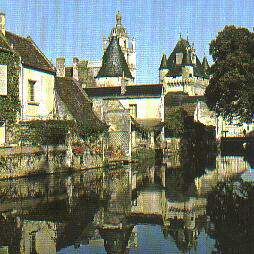 was much more dynamic than today but it has lost
much of its agricultural preponderance when Chinon got the nuclear plant and not
Loches. But the quality of life stays important, a natural beauty of the stones
and an animation invading the market places every Wednesday and Saturday
was much more dynamic than today but it has lost
much of its agricultural preponderance when Chinon got the nuclear plant and not
Loches. But the quality of life stays important, a natural beauty of the stones
and an animation invading the market places every Wednesday and Saturday
The strategic position at the summit of a hill made Loches a first quality
military bastion since Gallo-Roman times. The history of Loches is hereby very
strongly influenced by the history of its castle. Gregorius of Tours talked
already in the 6th century about a “castellum”. After Pepin le
Bref destroyed it in 742, Charles le Chauve (Charles the Bold) rebuilt it and
gave it to one of his vassals to end in the hands of the comtes d’Anjou from
the 10th to 13th century. It became soon a dispute between
England and France. Henri II of England had the time to fortify its foundations,
and later Richard Lion Heart and Philippe Auguste fought for its control. Bought
by Saint Louis in 1249 it definitely stayed in French hands.
Louis XI jailed and
tortured his enemies in the 15th when he reserved his iron cages for
them. The chateau was also the scene of the love between Charles VII and Agnes
Sorel. She flustered him her advices tenderly in his eras (on the pillow, it was
much easier and persuasive ;-). A few years earlier, in 1429, Joan of Arc came
to Loches to persuade Charles VII to join Reims to be crowned king. From the end
of the 15th century until the Revolution, the chateau was used only
as a prison. Which kept it in good shape. But what do you want? After all the
publicity Louis XI gave to this castle….
The chateau and dungeon are built separately, at the extreme north and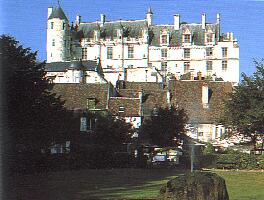 south
sides of the ramparts. You enter the elliptic plateau (circumference is 2 km),
which is the medieval citadel via the PORTE ROYALE from the 13th
century flanked by two later built towers (15th century). Take
now the rue Lansyer where you can visit two museums (musées Lansyer et du
Terroir). Before continuing to the chateau, have a short visit to the musée
Lansyer. This museum is mainly dedicated to the painter Lansyer who was a pupil
of Courbet but shows also some silk works and a splendid samurai armoury. At the
end of the garden the Musee du Terroir has a reconstituted Tours interior as
principal attraction. The street leads now to the eglise SAINT-OURS preceded by
a nice roman porch.
south
sides of the ramparts. You enter the elliptic plateau (circumference is 2 km),
which is the medieval citadel via the PORTE ROYALE from the 13th
century flanked by two later built towers (15th century). Take
now the rue Lansyer where you can visit two museums (musées Lansyer et du
Terroir). Before continuing to the chateau, have a short visit to the musée
Lansyer. This museum is mainly dedicated to the painter Lansyer who was a pupil
of Courbet but shows also some silk works and a splendid samurai armoury. At the
end of the garden the Musee du Terroir has a reconstituted Tours interior as
principal attraction. The street leads now to the eglise SAINT-OURS preceded by
a nice roman porch.
But that’s for next article.
Bibliography
Guide du Patrimoine, Centre, Val de Loire ,
by Perouse de Montclos (ed.Hachette 1992)—Het dal van de Loire, by A.Sperber
(Brussels, ed.Harenberg 1992),---Par les champs et par les greves, by G.Flaubert
(1885)—Guide du Routard 1998 (ed.Hachette)—de kastelen van Frankrijk, by
L.P.Boon (1956)-« England , eeuwige vijand van Frankuijk » (Final thesis, university of Louvain 1997)-« La longue histoire de
Loches et ses exactions », by Marie François de la Rosière (ed. Pucet,
Tours 1991)
|