|
back
to main page Loire valley
Back to
Chambord contents
Chambord, history and anecdotes
Chambord castle
visit |
““We were walking along
wide, empty galleries and desolated rooms where spiders laid their webs over the
salamanders of François 1er. You get such a harrowing and poignant feeling with
all this misery showing no beauty””
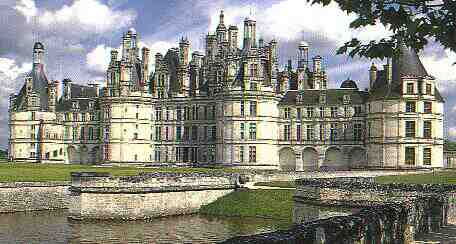
Tourists who are fighting
their way in the crowds visiting today the eye blinding chateau de Chambord will
not believe that Gustave Flaubert wrote this description about the exact same
building!
But when the writer loitered
around this largest chateau of the Loire (440 rooms and 365 open fires), in
1847, Chambord was not inhabited since a century, while the remaining furniture
was looted during the French revolution. Restoration was only started in 1932
when the state bought the property for 11 million francs.
The castle lies in a large
park, partly open for the public, surrounded by a 32 km wall (the longest wall
in France and the largest closed park pertaining to forests of Europe. 5350
hectares, which is equivalent to the surface of the city of Paris and its
surrounding suburbs!
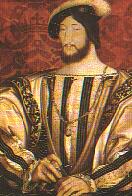 Francois 1er was a
passionate hunter and used to hunt in the forest of Boulogne. One day in 1518 he
decided to replace the existing small place Chambord by a large and royal
castle, basis for new hunts. It should become the symbol of the king's power. He
emptied the royal wallet and those of many churches. Starting the building in
1519, the exterior was finished in 1537 (1800 workers) but the residence was
really completely finished in 1545, two years before the death of François 1er.
After Francois
Francois 1er was a
passionate hunter and used to hunt in the forest of Boulogne. One day in 1518 he
decided to replace the existing small place Chambord by a large and royal
castle, basis for new hunts. It should become the symbol of the king's power. He
emptied the royal wallet and those of many churches. Starting the building in
1519, the exterior was finished in 1537 (1800 workers) but the residence was
really completely finished in 1545, two years before the death of François 1er.
After Francois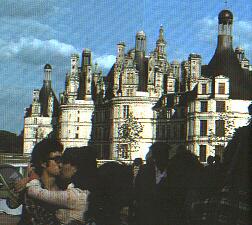 death, Henri II and Louis XIV finished all little details. It's
one of the marvels of the Renaissance and certainly the most celebrated chateau
of the Loire. Announcing Versailles, the chateau de Chambord was very
appreciated by Louis XIV because, let’s face it, the silhouette of the chateau
doesn’t evoke at all a military construction with its elegant aspect and
white, luminous stones. A great number of historians are inclined to attribute
the first building blue prints to Leonardo da Vinci, who lived not far from
there, in Amboise. death, Henri II and Louis XIV finished all little details. It's
one of the marvels of the Renaissance and certainly the most celebrated chateau
of the Loire. Announcing Versailles, the chateau de Chambord was very
appreciated by Louis XIV because, let’s face it, the silhouette of the chateau
doesn’t evoke at all a military construction with its elegant aspect and
white, luminous stones. A great number of historians are inclined to attribute
the first building blue prints to Leonardo da Vinci, who lived not far from
there, in Amboise.
Nobody ever lived
permanently in the chateau de Chambord.
It was mostly a ”come and
go” of complete prince or noble courts, especially attracted for the hunting
events. Quite a bizarre thing to compare with the periodical moving of the
European parliament today from Brussels to Strasbourg and the way back. Such arrivals were a problem and a blessing for the local peasants and
people living around. The court needed food, amusement and all what a noble,
lazy, non-working parasite wishes. My
excuses to the royalists).
Louis XIV had some sumptuous
and grand 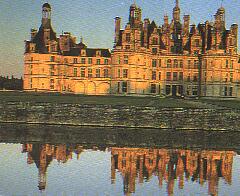 festivities here. To be more specific on those
"festivities", you must know that those times, these
"surprise-parties" often ended in "very special sexual
encounters", two, three or more involve, that was no problem! Indeed, the
lords invited often their companions in arms to sleep with them, as a sign of
chivalrous brotherhood. To share the bed of your lord and his spouse was one of
the great honours you could give to a friend. So, imagine the continuation!
festivities here. To be more specific on those
"festivities", you must know that those times, these
"surprise-parties" often ended in "very special sexual
encounters", two, three or more involve, that was no problem! Indeed, the
lords invited often their companions in arms to sleep with them, as a sign of
chivalrous brotherhood. To share the bed of your lord and his spouse was one of
the great honours you could give to a friend. So, imagine the continuation!
Louis XIV stayed 9 times in
the chateau between 1669 and 1685 and invited to enhance his evenings J. B.
Poquelin, much more known under his name: MOLIERE. The wrote in 1669 “Monsieur
Pourceaugnac”. But at the
premiere Moliere had to suffer that not one smile came over the face of the
king. The same happened with the “Bourgeois Gentilhomme” where the king
remained as a marble statue, cold and without a smile. Nevertheless he
congratulated Moliere and that was the start of his celebrity.
Stanislas Lesczynski, the
revoked king of Poland and father in law of Louis XV, stayed a few years in the
castle from 1725 on. He hated the filthy and moist atmosphere and therefore he
filled up the castle fosse.. From 1746 on Chambord became again full of
animation because this Stanislas offered the chateau as retreat-spot to the
Marechal de Saxe.
But enough history and
anecdotes. Let’s visit the castle but in my next article…
Bibliography
Guide
du Patrimoine, Centre, Val de Loire , by Perouse de Montclos (ed.Hachette
1992)—Het dal van de Loire, by A.Sperber (Brussels, ed.Harenberg 1992)—Par
les champs et par les greves, by G.Flaubert (1885)—Guide du Routard 1998 (ed.Hachette)—de
kastelen van Frankrijk, by L.P.Boon (1956)
-Chambord, magnificence et abandon, une histoire, by.H.Plakiewicz (ed.Bourdais
1991)-Visite du château Chambord (brochure)
|
|