|
Site Home - What's New?-Feedback - About Jack-Travel/Art Links |

NORMANDY
Le Havre in history
Le Havre in history
LE HAVRE is ranked second only to Marseille, even if this port exists only from the beginning of the 16th century. It's in 1517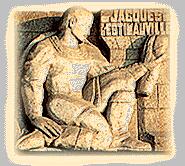 that king Francois 1er ordered the building of this harbors, since the one used until then, Honfleur, started to silt up. Anyway, Francois 1er was not a fool and "the silted-up mouth of the Seine" was only an excuse since his aim was, of course, to build an ideal base for an assault on the old enemy: the British.
He named the new settlement in all modesty: François-Ville. But success was something else. Royal ships ran aground on sandbanks until beacons were lit to guide them and the church was build so that prayers could be pressed to brighten up the future of this village.
But the sea is very naughty in these regions and regular floods carried the fishing fleets into the middle of the town and its flooded streets. But what could be worse than an English attack! And a successful one! Yes, the Earl of Warwick took possession for 10 months.
There was only one possible solution: change the name of this cursed city. And that's how François-Ville became Havre de Grace, later turning into Le Havre, while Richelieu executed the necessary works, like deepening the harbour.
The English came back in 1694 after bombarding Dieppe, destroyed most of the city and port. The Havrais found it an interesting opportunity to rebuild a new harbour in stone. But that was a gross misjudgement of the French. English are persistent, and came back again in 1759 with similar effect, but peace and alliance with the American colonies brought stability and prosperity. Following Le Havre's commitment to the "American rebels" and their support, ties with the United States grew stronger and in 1864, their first steamship, the "Washington" arrived, initiating a lucrative exchange of trade.
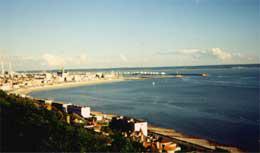 New disasters were in the make and occurred in the 20th century. Seen the strategic importance of Le Havre in WWII, fights in and around were extremely heavy. The historical part, near the harbour was so badly damaged that you can't see the contours of the city any more. Not only the enemy but also the Allied helped turning Le Havre into ruins. German bombs in 1940 and the target of Allied bombing in 1944. Even when Paris was liberated, Le Havre was still in German hands.
It is a pity but from all the rubble, only the Cathedrale Notre-Dame was entirely restored, and the rest rebuilt. It's unimaginable to picture Jean Paul Sartre, who taught in Le Havre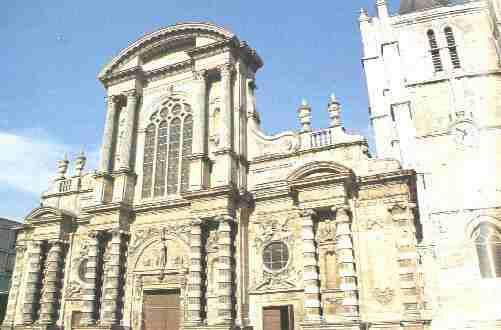 before WWII, strolling through the harbour cafes to have a drink.
Le Havre was entirely rebuilt and this was made possible by the breadth of vision of one man, the Parisian architect, Auguste Perret. Under the motto "space and simplicity" he created in a few years time, a whole new city centre, using mostly one material: reinforced concrete; It may feel a little bit boring, but the project can be labelled as a success. The large, straight streets don't look very tourist appealing but the city image is fascinating, if you look a bit deeper into it.
The suburb villages of Harfleur, Graville and Sainte-Adresse have a total different ambience: the character that you and me, love.
Next post, a visit of the city. Other Normandy places and memorials on my web site.
Bibliography
"Region Normandie, ses merveilles, ses cicatrices", by Louis Letellier (ed. Cloison, Rouen 1995, "Claude Monet : impressions of France : from Le Havre to Giverny" by John Russell Taylor, "Le peuple du Havre et son histoire" by Jean Legoy, "Hoog Normandie" by Sandra Vermoolen( ANWB reisgidsen,Den Haag)