|
The best known of the mountain villages
in Basque country is SAINT JEAN PIED DE PORT. Capital of Basse-Navarre and,
again, a wonderful and picturesque town.
Founded by the last great Basque king (Sancho the Strong) in the 13th century,
the town served as a military, commercial and religious cross-road, built on the
strategic junction between Pamplona, Bayonne and the north. The name “Pied de
Port”, means literally “foot of the pass”, a reference to the famous pass
Roncevaux where Charlemagne met with disaster against the vengeance of the
Basques. This important crossing of the Pyrenees was used by the Romans, and
also the Maures on their way to be defeated at Poitiers, and especially by the
pilgrims, who flocked through Saint Jean Pied de Port from the Middle Ages to
visit the tomb of St.James at Santiago de Compostella.
Today, this historical thoroughfare is a major attraction. The town is dominated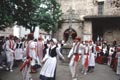 by a citadel, (falsely attributed to Vauban) from which you have superb views of
the town and the area around. Main street which descends steeply to the river is
perhaps the most picturesque in the northern Pays Basque with typical Navarra
houses built in rose-tinted granite and their histories engraved above the
doorways. The oldest dates 1510!! The scallop shell, symbolizing the pilgrims
of St.James, is seen as carved decoration on many of the houses as well as the
curious tradition of tying a sprig or twigs on the doors on St.Johns night in
order to “protect the household”. The “Bishops Prison”, which houses a small
museum, is built over medieval cellars often used in the past as the municipal
prison.
by a citadel, (falsely attributed to Vauban) from which you have superb views of
the town and the area around. Main street which descends steeply to the river is
perhaps the most picturesque in the northern Pays Basque with typical Navarra
houses built in rose-tinted granite and their histories engraved above the
doorways. The oldest dates 1510!! The scallop shell, symbolizing the pilgrims
of St.James, is seen as carved decoration on many of the houses as well as the
curious tradition of tying a sprig or twigs on the doors on St.Johns night in
order to “protect the household”. The “Bishops Prison”, which houses a small
museum, is built over medieval cellars often used in the past as the municipal
prison.
A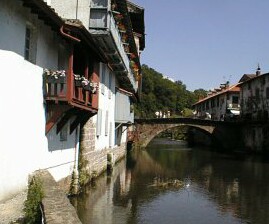 t
the bottom of this pretty street is the church of “Our Lady at the end of the
Bridge”, a curious but practical title. The medieval church was later restored
in the Neo-Gothic style and was part of the fortifications surrounding old town.
Trout can often be seen from the bridge, sunning themselves in the Nive and the
river fronts of the town houses with their balconies; it is the most well known
postcard of Saint Jean Pied de Port. t
the bottom of this pretty street is the church of “Our Lady at the end of the
Bridge”, a curious but practical title. The medieval church was later restored
in the Neo-Gothic style and was part of the fortifications surrounding old town.
Trout can often be seen from the bridge, sunning themselves in the Nive and the
river fronts of the town houses with their balconies; it is the most well known
postcard of Saint Jean Pied de Port.
The town is also the main market and commercial heart of the region (market day
is Monday) and is an ideal stopover to enjoy the local products: Irouleguy wine,
delicious Basque cake, ewe’s cheese, honey, wood carvings, sandal makers and
Basque furniture. It is also the obvious gateway to the mountains, particularly
to the ski fields and forest of Iraty and a highly recommended drive, crossing
the frontier and climbing the stunning valley to the pass of RONCEVAUX (1032
meters).
Just after the summit, the collegiate church of Roncevalles houses the first
early Gothic church (13th century) built in Spain, remarkable for its clear
lines and simplicity. Just next door is a Gothic cloister where, in a small
chapel, lies the tomb of the Basque king Sancho VII, the “Strong” of Navarra,
whose recumbent figure is 2,25 meters long, the real height of the monarch! A
beautiful stained glass window commemorates the last great battle in 1212 against the Maures when Sancho was apparently the first to break through the
chained slaves protecting the Maurish king.
against the Maures when Sancho was apparently the first to break through the
chained slaves protecting the Maurish king.
Continuing from Roncevalles, another hour’s drive will bring you to the capital
of Navarra, and the temporary home of Ernest Hemingway: Pamplona (Spain).
A shorter drive from Saint Jean Pied de Port is the stunning mountain valley
road to Saint-Michel and the village of Esterunçuby. To appreciate in
connoisseur of the Basque mountain scenery, this route is a must. |