|
From
Vaison we join MALAUCENE via the D 938 and here we are at the begin of the
northern climb to the MONT VENTOUX . Malaucene is one of the countless small
cities, forgotten by time, where history loses itself in endless local battles.
We will not be surprised by finding ruinous city walls, a fortified and mighty
church and a magnificent plane trees alley with shops from grandmother’s time
and a series of economically unjustified sleeping café terraces.
The D 974 leads us up the mountain. The landscape changes completely and takes
on other colours. This is the pays de SAULT where lavender is highly cultivated.
"""First, struck by the unaccustomed puff of the air and the vast
outspread of the spectacle, I was motionless of stupor,
dumbfounded.""" Petrarch once wrote, discovering the mont
Ventoux. Before the 19th century the trees on the slopes were
transformed into charcoal. The entomologist Henri Fabre described the mountain
at the end of the 19th century as “”” A big mass of stones,
like used to build road…a gigantic lime deposit, where the stones turn into
several pieces when you walk over them””
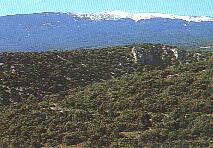 Dominating
the region by his 1909 meters, the mont Ventoux offers a unique post card. A
majestic bastion, its peak is ever white, whether it be from snow or
limestone, and is
recognizable from very far thanks to its bold, pyramid silhouette. Starting
to drive up from the lower area, it is ferny and forested and full of beautiful
spots where you can stop to enjoy a packed lunch. But when you get nearer the
summit, it turns into a very harsh, limestone area where the sun reflects of the
white of this higher part and the glare can be so great it can leave you
momentarily blinded. In this desert even experienced sheep
couldn’t survive. Dominating
the region by his 1909 meters, the mont Ventoux offers a unique post card. A
majestic bastion, its peak is ever white, whether it be from snow or
limestone, and is
recognizable from very far thanks to its bold, pyramid silhouette. Starting
to drive up from the lower area, it is ferny and forested and full of beautiful
spots where you can stop to enjoy a packed lunch. But when you get nearer the
summit, it turns into a very harsh, limestone area where the sun reflects of the
white of this higher part and the glare can be so great it can leave you
momentarily blinded. In this desert even experienced sheep
couldn’t survive.
The mont Ventoux (Mont des Vents, mount of winds) is called “lou Ventou” in
Provencal
language. Winds blow sometimes over 200 km an hour. She is the all-seeing mother
of all mountains and visible everywhere you stand (or almost). If I want to
exaggerate I would say that any spot from where you cannot see the Mont Ventoux
doesn’t belong to Provence ;-) The climate is harsh and it's not exceptional
that the mountain pass is closed until late Easter.
When the same poet Petrarca climbed in 1336 with his brother to the top of the
mont Ventoux, 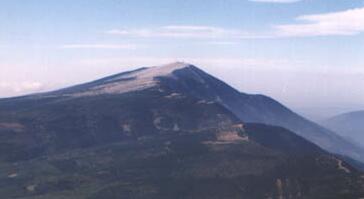 he makes a report in a letter of what we can consider as the first
modern route description in travelogue history. Petrarca and his brother were as
stunned at the top as we are today. The view is so wide that you don’t know
where to look first. When the weather is clear the view goes from the
Puy-du-Dome in the west to the Mont Blanc in the east. And when clouds do not
surround the mountain you have a great outlook on the summits of the Devoluy and
the Ecrins. Hold yourself on any nailed object when the mistral blows. It’s around the top that it is the wildest! he makes a report in a letter of what we can consider as the first
modern route description in travelogue history. Petrarca and his brother were as
stunned at the top as we are today. The view is so wide that you don’t know
where to look first. When the weather is clear the view goes from the
Puy-du-Dome in the west to the Mont Blanc in the east. And when clouds do not
surround the mountain you have a great outlook on the summits of the Devoluy and
the Ecrins. Hold yourself on any nailed object when the mistral blows. It’s around the top that it is the wildest!
On the top you have also the Chalet Reynard and the Chalet du Mont Serein. A TV
tower, radar station, radio and telephone transmitters for civil and military
purposes stand on the spot where there used to be a small chapel. A very large
parking lot can keep your car while you enjoy the views.
But at night, a sea of small light sparkles in the deep and with a little bit of
luck you could see the glow of the lighthouses on the Mediterranean.
Bibliography
"La
Provence devient francaise", by Roger Duchène (Fayard, Paris 1986)
"Guide de la Provence mysterieuse" and "Provence Antique"by
Jean-Paul Clebert (Ed.Sand, 1986),"The Roman remains of Southern
France", by James Bromwich (Routledge London 1993), “Aspects of
Provence, by Pope-Henessy James (Penguin Travel 1988), “Voyages de
Petrarque”, by J.Delannoé ( ed. Pampelune
, Arles 1989), “Le Vaucluse, pas une sinecure””by Roger de la Borge (ed.
Climats, Avignon, 1999)
|