|
This
city, world known for his Tartarin (hero of a book by Alphonse Daudet), symbol
of the Tarascon and the “Tarasque”, a horrible, cannibal water monster,
tamed by saint Martha. She changed him by waving a cross into a harmless little
puppy dog. Then she took her belt, ties it around the neck of the dog and offers
it to the stunned population. But they were so terrorised by the beast that they
chop it into little pieces, good for a liver pate.
Martha’s clemency was not only perceived by the Tarasque. After her death she guarded the city and its inhabitants. When the King
of the Franconians, Clovis, got sick in 500, besieging Avignon, he goes to
Tarascon to pray Martha. He heals and as reward he offers very large and vast
estates and prairies to the church of the city and decides that only the clergy
will rule Tarascon.
Like in Arles and Avignon the Rhone is not an integrated part of the image of
the city. If you walk through the high, meandering streets within the walls or
under the plane trees outside, there is nowhere you can feel the presence of the
river. The “bon roi René” built here a castle, still visited today because
of the Gobelin tapestries.
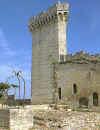 The
building of the CHATEAU began around 1400 and ended in 1449 when the bon roi René
furnished the interior with Gobelins and precious furniture. But he was the only
that would ever lodge in it. After his death the fierce edifice fell in decay
and was used from 1800 to 1926 as a jail. During the French revolution it was
the witness of ghastly horror scenes, where the Jacobins prisoners of which a
woman where stabbed by daggers and then thrown from the highest floor into the
Rhone. Nice epoch!!! The
building of the CHATEAU began around 1400 and ended in 1449 when the bon roi René
furnished the interior with Gobelins and precious furniture. But he was the only
that would ever lodge in it. After his death the fierce edifice fell in decay
and was used from 1800 to 1926 as a jail. During the French revolution it was
the witness of ghastly horror scenes, where the Jacobins prisoners of which a
woman where stabbed by daggers and then thrown from the highest floor into the
Rhone. Nice epoch!!!
In 1932 the State started grand restoration works that ended in the eighties.
Now the castle is open for the public and it’s worth visiting for the
magnificent view on the
roofs and terraces of the houses of Tarascon and the
surrounding landscapes. The chateau is open every day from 9.00 to 19.00 from
Easter to end September. Off-season from 9.00 to 12.00 and 14.00 to 17.00.
Paying.
In fact, being objective, this chateau is grandiose! It proudly rivals the
chateau de Beaucaire, which stands across the river.
The interior of the castle is mostly empty but changing exhibitions of modern
abstract creates a striking effect against the severe medieval walls. No
furnishings but six magnificent 17th century tapestries. Back in Tarascon we have two more things to do. A discovery stroll through the
old centre where we will glance at the elegant hotel de Ville from 1648, the 16th
century Cloitre des Cordeliers, also with an old pharmacy, the rue des Halles
with its intimate arcades and eventually a visit to the SOULEIADO fabrics
factory in a 14th century maison de maitre in the rue Proudhon no.39,
tel 0490910880. I know many of my readers are passionate of that Souleiado
fabrics. You can see the 17th century press blocks imported from
India with the motives that made the success of these “indiennes” and still
do. It is open on rendezvous from 10.00 to 15.00 from Monday to Saturday.
The second visit is the HOUSE OF TARTARIN DE TARASCON, 55 bis boulevard Itam tel
0490910508. Closed on Sunday and from Dec 15 to March 15.
 Daudet created the personage of Tartarin in 1872. He painted him as a vain,
swanky, braggart, lying and ridiculous person always ready to get involved in the most extravagant
adventures. See an extract:” In the Midi they don’t lie, they make mistakes.
They don’t tell always the truth but they think they do…its own lie is not a
lie but a sort of delusion." The citizens of Tarascon have never been able
to live this reputation down. They'll tell you how little they appreciate being
known as the compatriots of Tartarin. But it is finally thanks to Daudet that the city got so famous.
They created a tiny museum to the character in 1985: LA MAISON DE
TARTARIN. It's a silly place, only for those who know the book well.
In
the garden you can see the portrait of the monster ”Tarasque”.
Daudet created the personage of Tartarin in 1872. He painted him as a vain,
swanky, braggart, lying and ridiculous person always ready to get involved in the most extravagant
adventures. See an extract:” In the Midi they don’t lie, they make mistakes.
They don’t tell always the truth but they think they do…its own lie is not a
lie but a sort of delusion." The citizens of Tarascon have never been able
to live this reputation down. They'll tell you how little they appreciate being
known as the compatriots of Tartarin. But it is finally thanks to Daudet that the city got so famous.
They created a tiny museum to the character in 1985: LA MAISON DE
TARTARIN. It's a silly place, only for those who know the book well.
In
the garden you can see the portrait of the monster ”Tarasque”.
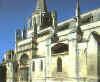
Finally the EGLISE SAINTE MARTHE is an interesting eclecticism of architecture,
built half roman in the 12t century and half gothic in the 14th. Most of the
bas-reliefs that once decorated its doorway were destroyed during the revolution. But
nothing has touched the remarkable crypt. It's worth descending to visit.
Oh yes, for the amateurs: every year a great celebration market is held on the
last Sunday in June to remember Tartarin the terrible Tarasque.
Bibliography
A
guide to Provence, by Michael Jacobs (Viking, London 1988), Mémoires
d’un touriste, by Stendhal (Pleiade, Paris 1992), "Guide
de la Provence mysterieuse" and "Provence Antique"by Jean-Paul
Clebert (Ed.Sand, 1986 “Aspects of Provence, by Pope-Henessy James (Penguin
Travel 1988-Guides du Routard, (1999)-Beaucaire, Tarascon, débuts du Languedoc,
by H.Landau (presses Cité-1991)
|