|
Leave Les Baux by the D 78
and turn right as soon as you arrive
 on
the D 17 to Fontvielle. on
the D 17 to Fontvielle.
FONTVIEILLE is a typical Provencal village that owes a lot of its fame to
Alphonse Daudet. Did you ever read (maybe in an English translation) “Lettres
de mon Moulin”? It describes vividly the 19th century Provencal way
of life in the countryside. A pity that it is known now that he was an
anti-Semite and hated Jews. He came to Fontvieille when he was 20 and returned
during 30 years to visit his cousins Ambroy, living in “Montoban” (later Montauban)
just outside the village. There were at least 4 corn mills in Fontvieille and
the nearest to “Montoban” was the “Moulin Tissot”. It is probable that
it is this mill that inspired 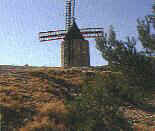 Daudet for his novels. An alley of pine tress lead
to the old mill. It is surrounded by cypresses and houses a small Daudet museum.
Van Gogh made a drawing of the mill in 1888. The countryside didn’t change
much since that time, just a big parking lot between the chalk rocks. Daudet for his novels. An alley of pine tress lead
to the old mill. It is surrounded by cypresses and houses a small Daudet museum.
Van Gogh made a drawing of the mill in 1888. The countryside didn’t change
much since that time, just a big parking lot between the chalk rocks.
Other site to see in
and around Fontvieille are the Roma, ruins of Caparon, the fort at Paon and the
castles of Estoublon, Barbegal and Montauban. And the abbey of MONTMAJOUR, in
principle part of the Arles area is not far from here. But that's for the
Camargue chapter.
Return on the D 17 and take now the opposite direction to MAUSSANE and enter the
proper ALPILLES area. Maussane is with its old oil mills, a washing-cleaners from last
century, the FONTAINE DES QUATRE SAISONS and the chateau de MONBLAN, an
attractive little town with beautiful houses and squares. I insist on the chapel
“Oratoire de Saint-Marc”, 14th century in a moving simplicity.
The 18th century church Sainte-Croix is also worth a visit.
Next village is MOURIES where there are only remains of the Fort Castelles
destroyed in 1394 by the Comte de Turenne. But it’s worth to pay a visit to
the church of Saint-Jacques le Majeur, the chapel Saint-Symphorien and the
excavations of the oppidum of Servanes. Mouries is the village in France with
the highest olive oil
production.
At the southern flank of the Alpilles, where the plateau of Crau begins, lies
the village AUREILLE a small village obviously named after the “Via
Aurelia”. A lot of ruins testify here of centuries of history. Besides a
medieval caste ruin you can visit the remains of 11th century church
and its bell tower that was covered by a cupola. Aureille is also known for its
non-bloody bullfights.
Now we arrive in the heart of the Alpilles where the splendid village of EYGALIERES has the reputation to have a very healthy climate. In
Eygalieres you
can see a few nice roman chapels like Saint-Pierre de Vence, Saint-Sauveur and
Saint-Veredeme. Other chapels, Gallo-roman burial places, prehistoric locations
and few protected houses like the MAISON GARCIN. In the
hot season both fountains of Eygalieres are the main attraction: the FONTAINE
BORMES-LA-COQUILLE from the 18th and the FONTAINE CROIX-DU-PRECHE,
also named “cocotte”, a Renaissance jewel.
Via the N 569 you can join ORGON with Roman and medieval ruins, pretty
Renaissance facades with a magnificent view on the valley of the Durance and the
Luberon mountain range. This is an extremely pretty village. Old traditions
remained in this village, as lively as the traditional yearly market held end of
September.
Bibliography
"La
Provence devient francaise", by Roger Duchène (Fayard, Paris 1986)
"Guide de la Provence mysterieuse" and "Provence Antique"by
Jean-Paul Clebert (Ed.Sand, 1986),"The Roman remains of Southern
France", by James Bromwich (Routledge London 1993), « Old Provence »,
by Th.A.Cook (Rivingtons, London 1914), “Aspects of Provence, by Pope-Henessy
James (Penguin Travel 1988)« Dictionnaire de la France médievale »,
by Jean Favier (Fayard, Paris 1993), “La Provence Romane”, by Jean Maurice
Rouquette (Zodiaque, Yonne 1974).
|