|
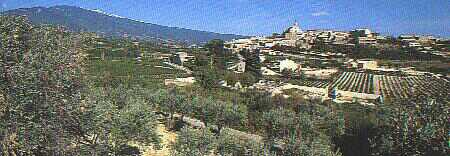
From
the city of Orange, that I will describe the day the Front National will be
beaten at the elections, we can crisscross the princedom in its full length via
Camaret-sur-Aigues and Gigondas towards Vaison-la –Romaine. This route will
lead us to the heart of Provence, visible entirely from the top of the Mont
Ventoux. The DENTELLES DE MONTMIRAIL are one of the pleasant surprises that
Provence gives us regularly.
Dentelles means lace in French, which should give you a good hint as to
its rock apppearances.
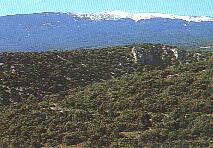 In
the center of Serignan we take the D 43 to Camaret and then the D 67 to Violès,
running right on the DENTELLES DE MONTMIRAIL. The road winds now through
numerous vineyards, already a part of the Gigondas area. We can off course not
ignore the famous wine cellars. The city was called "Jocunditas"
by the Romans, meaning joy and cheerfulness. They guessed it right. And the
amateurs of good "crus" of wine will not neglect, in joy and
cheerfulness, to have some tasting of this excellent "cru", one of the
most reputed of the cotes-du-rhone. A road leads from here to
the DENTELLES SARRASINES, the center of the DENTELLES DE MONTMIRAIL. This
mountain range, not higher than 2200 feet presents very
picturesque vertical walls, in a silvery grey, emerging with their sharp crests
amidst typical Mediterranean vegetation. Between Vaison la Romaine in the north
and Beaumes de Venise in the south they form a steep décor of dented rocks
having their highest point at Saint-Amand (734 m). We drive now from Gigondas,
direction Col du Cayzon, on a horrible road full of holes, but drivable. When
the road becomes a dead end in the vineyard property Clos Bois de Menge, we are
at the foot of the DENTELLES SARRAZINES, amidst small wine fields and surrounded
by high white walls. Looks like a natural fortification with the white notches
contrasting sharply against the blue sky. Amateur and debutant mountain climbers
train here often in their heavily coloured anoraks. The atmosphere is pure and
quiet. All reasons to forget your car and go walking on adventure. In
the center of Serignan we take the D 43 to Camaret and then the D 67 to Violès,
running right on the DENTELLES DE MONTMIRAIL. The road winds now through
numerous vineyards, already a part of the Gigondas area. We can off course not
ignore the famous wine cellars. The city was called "Jocunditas"
by the Romans, meaning joy and cheerfulness. They guessed it right. And the
amateurs of good "crus" of wine will not neglect, in joy and
cheerfulness, to have some tasting of this excellent "cru", one of the
most reputed of the cotes-du-rhone. A road leads from here to
the DENTELLES SARRASINES, the center of the DENTELLES DE MONTMIRAIL. This
mountain range, not higher than 2200 feet presents very
picturesque vertical walls, in a silvery grey, emerging with their sharp crests
amidst typical Mediterranean vegetation. Between Vaison la Romaine in the north
and Beaumes de Venise in the south they form a steep décor of dented rocks
having their highest point at Saint-Amand (734 m). We drive now from Gigondas,
direction Col du Cayzon, on a horrible road full of holes, but drivable. When
the road becomes a dead end in the vineyard property Clos Bois de Menge, we are
at the foot of the DENTELLES SARRAZINES, amidst small wine fields and surrounded
by high white walls. Looks like a natural fortification with the white notches
contrasting sharply against the blue sky. Amateur and debutant mountain climbers
train here often in their heavily coloured anoraks. The atmosphere is pure and
quiet. All reasons to forget your car and go walking on adventure.
 Alas, we
must return the same way back and in Gigondas take the small D 23
via SABLET, a small-market town with green spaces and loved by writers for its
quietness at the foot of the Dentelles. SEGURET will be next stop. A charming
village with its steep streets and old gate, belltower, fountain, church and
castle, is one of the most beautiful
villages of Provence. It is worth to walk through Main
Street, looking more like a chasm. We pass the miniscule place de la Liberation
where the CAFÉ DES POTERNES has the most beautiful terrace with view on the
mountains and vineyards of the Provence. The same with a terraced restaurant
"Le Mesclun". Seguret is one of those strange
open-air museum, restored with a lot of money and taste, but where you hardly
encounter a living soul, except the cat at the washing square. Alas, we
must return the same way back and in Gigondas take the small D 23
via SABLET, a small-market town with green spaces and loved by writers for its
quietness at the foot of the Dentelles. SEGURET will be next stop. A charming
village with its steep streets and old gate, belltower, fountain, church and
castle, is one of the most beautiful
villages of Provence. It is worth to walk through Main
Street, looking more like a chasm. We pass the miniscule place de la Liberation
where the CAFÉ DES POTERNES has the most beautiful terrace with view on the
mountains and vineyards of the Provence. The same with a terraced restaurant
"Le Mesclun". Seguret is one of those strange
open-air museum, restored with a lot of money and taste, but where you hardly
encounter a living soul, except the cat at the washing square.
Find the very cute road D 88 that winds to the D 977. The road continues, still
superb, with view on the Dentelles. It will lead you to Vaison.
Bibliography
"La
Provence devient francaise", by Roger Duchène (Fayard, Paris 1986)
"Guide de la Provence mysterieuse" and "Provence Antique"by
Jean-Paul Clebert (Ed.Sand, 1986),"The Roman remains of Southern
France", by James Bromwich (Routledge London 1993), « Old Provence »,
by Th.A.Cook (Rivingtons, London 1914), “Aspects of Provence, by Pope-Henessy
James (Penguin Travel 1988)« Dictionnaire de la France médievale »,
by Jean Favier (Fayard, Paris 1993), “La Provence Romane”, by Jean Maurice
Rouquette (Zodiaque, Yonne 1974).
|