Site Home - What's New? -Feedback - About Jack- Travel/Art Links

Provence
|
Site Home - What's New? -Feedback - About Jack- Travel/Art Links |
|
|
|
Provence |
|
Jack's Provence travels |
|
|
Provence-Fontaine de Vaucluse |
Mont
Ventoux
|
||
|
From
L’Isle sur la Sorgue to FONTAINE DE VAUCLUSE is a distance of 10 km. We can go
and see where the water from the pure Sorgue comes from that runs to Avignon to
disappear in the Rhone. Alas!! Only the river Sorgue stayed pure in this
FONTAINE DE VAUCLUSE, a total prey for the tourist industry!
If you can avoid going there on a Sunday, avoid it !
While the “fountain”
is reachable, even tangible and thus touristically understandable, I can not
believe that the slightest percentage of the many ten thousand yearly tourists
who march between the souvenir tents and French fries booths on the shores of
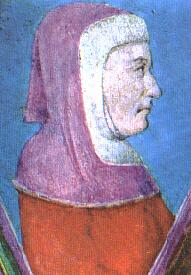
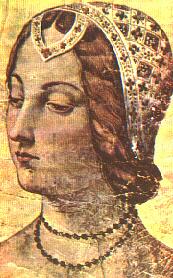
the Sorgue, have the faintest idea of what Petrarca wrote or even who Petrarca
is. It is already since the 17th century that the village is
overflowed by “tourists” who wanted to be on the spot where the poet was so
unhappy (poetically). Bibliography A
guide to Provence, by Michael Jacobs (Viking, London 1988), The Ventoux summit.,
the secret, by Petrarca (Ambo, Baarn 1990), Mémoires d’un touriste, by
Stendhal (Pleiade, Paris 1992), "Guide
de la Provence mysterieuse" and "Provence Antique"by Jean-Paul
Clebert (Ed.Sand, 1986 “Aspects of Provence, by Pope-Henessy James (Penguin
Travel 1988), “Le Vaucluse, pas une sinecure””by Roger de la Borge (ed.
Climats, Avignon, 1999)-Guides du Routard, (1999) |
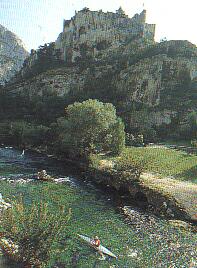 second. Needless to say, this natural spectacle is very impressive and is
visited from all over the world. Emerald green waters gush forth from the
underground river and such famous investigators like Jacques Cousteau have
explored it. As you guessed it already I
have an aversion against this village where all the snack bars and ice cream
joints are named Petrarca and Laura. But sometimes, on a moonlighted evening in
October it can be beautiful. A warm light comes out of the silent houses and you
hear the Sorgue mumble.
second. Needless to say, this natural spectacle is very impressive and is
visited from all over the world. Emerald green waters gush forth from the
underground river and such famous investigators like Jacques Cousteau have
explored it. As you guessed it already I
have an aversion against this village where all the snack bars and ice cream
joints are named Petrarca and Laura. But sometimes, on a moonlighted evening in
October it can be beautiful. A warm light comes out of the silent houses and you
hear the Sorgue mumble.