|
VAISON LA ROMAINE thanks its
reputation to a pastor named Joseph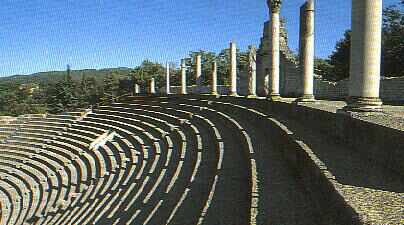 Sautel. He started in 1907 to dig after
Roman remains and continued until his death in 1955. He had also read the book
of Prosper Merimée “Notes d’un voyage dans le Midi”, who noted in his
diary in 1834 that the city was obviously built on antique remains. Built by the
Romans on a flat area of land on the east bank of the river Ouvèze, it's the
bulk of Vaison today. Digs in the ancient part of the city have been done in
such a way that you can begin to visualise something about life in Roman Gaul. In fact
the excavations must be divided in two parts: Quartier du Puymin and quartier de
la Villasse.
Sautel. He started in 1907 to dig after
Roman remains and continued until his death in 1955. He had also read the book
of Prosper Merimée “Notes d’un voyage dans le Midi”, who noted in his
diary in 1834 that the city was obviously built on antique remains. Built by the
Romans on a flat area of land on the east bank of the river Ouvèze, it's the
bulk of Vaison today. Digs in the ancient part of the city have been done in
such a way that you can begin to visualise something about life in Roman Gaul. In fact
the excavations must be divided in two parts: Quartier du Puymin and quartier de
la Villasse.
Named the French Pompei, these excavations are not all of very big
historical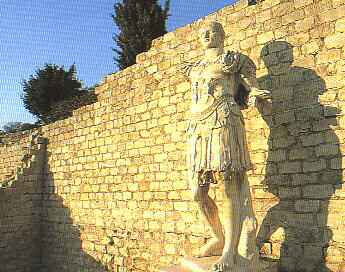 importance, but there are many. The most impressive results of the diggings are
to see along the COLLINE DU PUYMIN with the vast villa des Messii at the
beginning. Here a theatre of 7,000 spectators was excavated. Please avoid this
enormous complex for a detailed description by local guides during the summer,
you could get trampled! Very frequented touristy site, Vaison is the third most
visited place in the Vaucluse.
importance, but there are many. The most impressive results of the diggings are
to see along the COLLINE DU PUYMIN with the vast villa des Messii at the
beginning. Here a theatre of 7,000 spectators was excavated. Please avoid this
enormous complex for a detailed description by local guides during the summer,
you could get trampled! Very frequented touristy site, Vaison is the third most
visited place in the Vaucluse.
Walk down through town and cross the Roman bridge to see the medieval village
perched on a rocky outcrop.
|
|
|
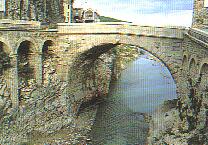
Bridge over Ouveze |
Today, the city extends on
the two banks of the Ouveze. This bridge over the Ouveze is for me one of the
most important witnesses of the presence of the Romans in Provence. Despite all
romantic ideas about old bridges, there are only five bridges left in Provence
dating from Roman times and this one is one of them. The bridge you see now
didn’t change since it was built. Only the stone rail that was added in the 19th
century disappeared in the violent streams of the catastrophic flood of 1992.
The bridge alone is worth a study, having only one arch of 17 meters opening.
After a steep climb to the old city “haute ville” we can explore the narrow
streets where almost all
houses have been restored with a lot of private care and money. We meet mostly
neat Germans in white sport shorts and white sport Mercedes. A little too much
Mont-Saint-Michel if you ask me, although the sea is far ;-)
The oldest house is from the 16th century. Superb
Renaissance facades like almost
all houses.
See the fortified door surmounted by a belfry, the church,
built in many styles and serving as a cathedral until the French revolution. The
church is closed now because it is very dangerous to walk inside because of roof
collapse danger! The same for the ruins of the fortified castle on top, built in
the 12th century by the unlucky counts of Toulouse. It is a big
disappointment for all those who started the steep climb to find out the castle
is closed! Pass also the place du
Vieux-Marche, rue des Fours, le quartier de la Juiverie...
Going down again to
the old city life seems to have recovered after the dramatic floods. In the
pedestrian streets the merchants complain again just like in old times about the
shoplifters who get more and more daring when the tourist season approaches. Not
only the well-filled wallets disappear from the tourist’s pockets but complete
cars with all inside and outside disappear from the parkings.
Go and visit "L'Espace vins" in the house of tourism, place de
l'Abbe-Sautet. Sale and tasting of wines and juices.
Feasts, festivals
------------------------
Soirees du Theatre Antique : from 12 to 25 July. Dance, theater,
concerts.
Les choeurs laureats : end July-beginning August. In the cathedral.
Biggest choir festival of Europe. "European Choral City" since 1993, Vaison la Romaine is a hymn to peace and beauty which welcomes musical meetings.
Journees gourmandes: beginning November. You can imagine what this is ;-). The
arts of preparing the regional products and how to eat them. But or that you
must buy first!! :-)
Bibliography
"La
Provence devient francaise", by Roger Duchène (Fayard, Paris 1986)
"Guide de la Provence mysterieuse" and "Provence Antique"by
Jean-Paul Clebert (Ed.Sand, 1986),"The Roman remains of Southern
France", by James Bromwich (Routledge London 1993),
Prosper Merimée “Notes d’un voyage dans le Midi”, « Old
Provence », by Th.A.Cook (Rivingtons, London 1914), )« Dictionnaire
de la France médievale », by Jean Favier (Fayard, Paris 1993), “La
Provence Romane”, by Jean Maurice Rouquette (Zodiaque, Yonne 1974), Guide du
Routard 1988 (ed.Hachette)
|