|
We descend now along the
southern slope on the D 974 direction Beaumes de Venise and in a stone desert we
pass the tomb of the English bicycle champion Tom Simpson. During the Tour de
France 1967 Tom Simpson fell off his bike, under a burning sun, and died a few
moments later, probably because he ingested stimulating doping pills before the
daily etape.
But
let’s enjoy the rich forests on this southern slope and let’s meet again in
small BEDOIN nestled on the first counter forts of the Mont Ventoux. A
horrifying store is attached to this village. The tragedy took place in May 1794
and was typical of the lack of enthusiasm that the citizens of this quite
religious and catholic region showed for the French revolution.
In that calamity year a so-called “liberty tree” was planted in Bedoin,
ordered by revolutionary authorities. But a few days later the tree disappeared,
since the population was not very happy with this pagan symbol. The consequences
were disastrous! The Comité de Salut Public ordered a battalion commander,
Louis Suchet, to take his soldiers from Marseille and send them to Bedoin to
teach these « counter revolutionaries » a lesson. He assembled 63
inhabitants and shot or decapitated them. The he gave the order to burn down the
church and the whole village. This Suchet became later one of the favourite
field marshals of Napoleon and in 1826 he was buried as a respected, upright and
honest person. In Bedoin you can find on the place du Marché and under the
plane trees on the side a modest monument reminding Suchet’s terrorist
actions. The inscriptions disappeared during the 1830 revolution. And only
insiders and researchers like your Jack know what happened in this tiny village
in 1794.
Anyway, Bedoin is surrounded today by the largest communal forests of
France . This village is the ideal base for the bicycle
freaks that want to climb this mythical road to the top of the Ventoux, thinking
they have the power of Tour de France cyclists. Some slopes have a declivity
going up to 16% !!
After Bedoin we arrive on the D 938 going from Malaucene to Carpentras. Take
direction
Carpentras and when you are at the crossing of the D 21 turn right to BEAUMES DE
VENISE. You will enjoy the drive, for it's an especially pretty one, one road
lined with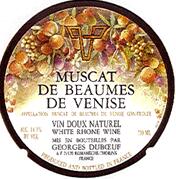 vineyards and neat rows of cypresses.
Pretty village on the southern slopes of the Dentelles de Montmirail, Beaumes is
worth the visit for three reasons. First for its heavenly Muscat wine, said to
be the best in France, to drink cool, as aperitif or even better as dessert wine
and has the very dangerous property that you can’t stop drinking until the
bottom is empty! The “melon au Muscat” may give you the envy to stay another
day! You can buy and taste in the "Cave des Vignerons". The red wines
are less known than the Gigondas but are excellent.
A second reason is the neighbouring impressive roman
Notre Dame d’Aubune. It lies a little bit over the plateau with safe Dentelles
in its back and the most wonderful about is its tower that in its unusual length
rises dunning and winking high above the modest small church. It was probably
built in the 8th century as a token of gratitude for the victories of
the French against the Arabs near Tours and Poitiers. The tower dates from the
13th century. Finally,
Beaumes is the ideal spot to leave you car and explore (in low season) the D 90
leading to Suzette and along the Cirque de Saint-Amand back to Malaucene on the
highway. It's a dreamland like Arcadia that we enter here with small
vineyards enclosed by protecting rocks, with plenty of pine trees, parasol pines
and Christmas oaks. Everywhere a scintillating white mountain appears under a
deep blue sky and we would like to live in every small house hidden in the
greenery.
Let’s go now to Carpentras where we will meet in next article.
Bibliography
"La
Provence devient francaise", by Roger Duchène (Fayard, Paris 1986)
"Guide de la Provence mysterieuse" and "Provence Antique"by
Jean-Paul Clebert (Ed.Sand, 1986),"The Roman remains of Southern
France", by James Bromwich (Routledge London 1993), “Aspects of
Provence, by Pope-Henessy James (Penguin Travel 1988), “Le Vaucluse, pas une
sinecure””by Roger de la Borge (ed. Climats, Avignon, 1999)-Guides du Routard (1999)
|