|
SARE is another of these very special
Basque villages. Surrounded by superb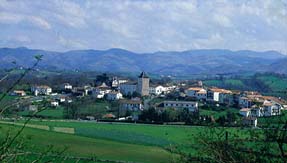 Basque farm houses, it lies in the shadow of the “Rhune” mountain and in the
heart of the old smuggling region.
Basque farm houses, it lies in the shadow of the “Rhune” mountain and in the
heart of the old smuggling region.
The Basques never recognized the legality of the frontier and considered the
transportation (“night work”), while avoiding custom formalities, as perfectly
natural! With over 20 km of easy mountain passages nearby, Sare became an
important smuggling centre.
Pierre Loti, in his famous romantic novel “Ramuntcho”, used Sare as the site of
the fictional town of Etchjar, and portrayed an excellent image of 19th century
village life, including the importance of the pelote game and the smuggling.
Loti even participated in a real smuggling expedition to provide material for
his novel!!
Today, Sare may be admired for its beautiful village square, dominated naturally
by the fronton, the church and mayor’s office. The houses, some built with
arcades date from the 17th and 18th century. Not to be missed are the
prehistoric grottos of LEIZA—a sound and light show of a prehistoric world.
Driving up the Nive river valley from Bayonne, via the villages of Bidarri,
Osses and St.Martin d’Arossa, take the signposted right-hand turn to SAINT
ETIENNE DE BAIGORRY and the beautiful valley of the Aldudes with the villages of
Banca, Les Aldudes and Urepel. Baigorry is situated in one of the most beautiful
valleys in the northern Basque country and offers a rich variety of mountain
scenery.
Following a tributary of the Nive river, the long valley eventually reaches the
Spanish border (the mountain pass of Ispeguy is a spectacular drive!), passing
country (where the Romans once mined for copper and silver) and which was also
often disputed over for pasture rights between France and Spain. Today, the
peculiarity of the region is that grazing ground is shared by both countries
under mutual agreement.
Baigorry owes its name to the rose-colored granite and soil in the area, which when in flood, gives a particular tinge to the Nive river (Baigorri = red
river). The rose granite is used widely to build farms and houses and the
architecture is typical of the valley and of the Basse-Navarre.
when in flood, gives a particular tinge to the Nive river (Baigorri = red
river). The rose granite is used widely to build farms and houses and the
architecture is typical of the valley and of the Basse-Navarre.
In this glorious part of the Basque country lies the local vineyards of
Irouleguy with the nearby villages of Anhaux, Lasse and Ascorat. A wander
through this area will wet your appetite for authentic and beautifully preserved
countryside.
The valley of Baigorry lies in a fold of the Pyrenees in the province of Basse-Navarre.
The Nive riverside and the eleven villages of the valley have a charming and
traditional rural character. In this mountainous environment there are numerous
opportunities for nature lovers. You can use the well marked tracks, together
with many hikers, mountain-bikers, on those on horseback will easily discover
the richness of the Basque hinterland. River sports like rafting at Biarri, as
well as canyoning, rock climbing and trekking---sensations guaranteed! |