|
The most mountainous of the three French
Basque provinces is undoubtedly the SOULE.
It is a different world compared to Labourd province. Here, life is simpler and
tougher during winter when there is ample snowfall. The population is sparse,
towns are small but the nature is breathtaking and certainly worth the visit.
From Saint Jean Pied de Port the road (take first the direction to St.Jean le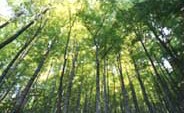 Vieux) twists and climbs to the forest of IRATY, one of the largest mountain
forests in Europe. The views are perfect postcard subjects and there are picnic
facilities and forest walks to be enjoyed. During wintertime the ski station of
Iraty is popular for cross country skiing. The site is also popular as an
observation post for the migratory passage of birds as they head south over the
Pyrenees in the fall. Today, the forest of Iraty is protected, after the forest
was decimated during three centuries for the needs of shipbuilding.
Vieux) twists and climbs to the forest of IRATY, one of the largest mountain
forests in Europe. The views are perfect postcard subjects and there are picnic
facilities and forest walks to be enjoyed. During wintertime the ski station of
Iraty is popular for cross country skiing. The site is also popular as an
observation post for the migratory passage of birds as they head south over the
Pyrenees in the fall. Today, the forest of Iraty is protected, after the forest
was decimated during three centuries for the needs of shipbuilding.
On the other side of Iraty the road (D 26 and then D 113) can be taken to the
impressive gorges of Kakouetta. The canyon is a 3, 5 km walk (two hours
approx.for the return trip). The width varies from 3 to 10 meters and the depth
of the gorge measures 200 meters.
Back to the description of the SOULE. It is also a province rich in legends,
with one of the oldest languages in the world, the Basque “Euskara”. All is
woven harmoniously into the land and the everyday lives of its people.
Shepherds, dancers, singers, pelote players, invention of the espadrille (sort
of sandal), the Souletins (inhabitants of the Soule) remain faithful to their
heritage. The tradition of welcoming is respected and expressed in the
architecture along the pilgrim routes to Santiago of Compostella.
Springs, caves, canyons and mountain pastures provide an ever-changing landscape
with numerous footpaths crossing plateaus to hikers, not mentioning forests and
meadows.
In the Soule the fete de village (village feast), reflects living traditions.
Sport, religion and entertainment draw the people to the village square, in
front of the Soules unique three-gabled bell towers and the pelote frontons.
The square hosts also the famous “pastorale”, a folk theatre that has roots in
the mystery plays of the Middle Ages. The villagers create a spectacle of song,
dance, history and legend renewing of the Soule from generation to generation.
Capital of the Soule, MAULEON is the economic heart of the region and has a past stretching back to the Middle Ages. Its castle is one of the most important
medieval forts in the region with thick walls built to withstand cannonballs
impressive towers, draw-bridge and vaulted prison. It dominates the upper and
older part of Mauleon and can be visited.
past stretching back to the Middle Ages. Its castle is one of the most important
medieval forts in the region with thick walls built to withstand cannonballs
impressive towers, draw-bridge and vaulted prison. It dominates the upper and
older part of Mauleon and can be visited.
Mauleon is also reputed for its shoemaking industries. Sandals were the main
item produced here in the 19th century and today the town accounts for 70
percent of the espadrille (sandals) manufacturing in France!!
In the lower part of the town, two splendid renaissance buildings are open for
visit, the Hotel de Maytie and also town hall, formerly the Hotel de Montreal,
built in the 17th century.
To finish my series about Basque country, I will lead you to LARRAU, small
village nestled at the foot of Mount Orhy, the highest peak in Basque country
(2,017 meters). Like all its neighbors it blends well into the countryside and
traditions of the Soule province. Its surrounding farms merge into the mountains
with poetic names.
Typically like all others, the attractive village centre is grouped around the
historical church and the fronton. This church was restored in 1656 but original
vestiges include the apse built in Roman style and a decorated wooden statue of
Virgin Mary.
It was originally built as a place of worship and then a hospital, also for the
pilgrims, who were following the Roncal or Salaza valleys to Pamplona via the
Larrau pass.
The pilgrims found shelter half way up at 1,300 meters in the hermitage chapel
of Saint Joseph, built by monks in 1656.
The chapel was restored in 1861 and again rebuilt after a heavy snowstorm in
1990 by the community of Larrau who respected the old stone wall architecture. |