|
Before starting with town
hall let’s tour around the square and start at the
northern corner. Follow the opposite side as the needles of a clock. At no.1
stands the ROI D’ESPAGNE (1696-1697) once a guild house of the bakers, now a
well-known café. Juts above the entrance you can see medallions of emperor Marc
Aurelius, Nerve, Decius and Trajan. At the second floor the bust of king Charles
II of Spain, accompanied by an Indian South American prisoner and a more.
At no.3 “La Brouette” ‘1655-1645), ancient corporate house of the fat and
oil merchants, also transformed into a café, and which survived partly the
bombing of 1635. No.4 “Le Sac” (1645-1646 restored in 1697) was the house of
the cabinet-makers and coopers. No.5 (1696) “La Louve” was the Archers
house. Look on the façade, you’ll see a bas-relief showing a female wolf
giving Romulus and Remus some milk. At no.6 (1697) “Le Cornet”, house of the
boat and ferry men with a frigate on its fronton. No.7, “Les Renards” was
the house of the Mercers.
 But
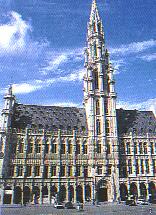
the unavoidable star of the Grand Place is the magnificent “HOTEL DE VILLE”
(Town Hall), one of the most important examples of civil gothic architecture in
Europe. Its 96-meter spire, mounted by the gold statue of Saint-Michel, patron
of the city, is finally liberated from the scaffolding that covered it for so
many years. When it was erected in the beginning of the 15th century
(1402) it was supposed to overtake the one in Bruges by its height. The French
bombardment in 1695 destroyed it but spared the spire. Town hall was rebuilt
identical. But
the unavoidable star of the Grand Place is the magnificent “HOTEL DE VILLE”
(Town Hall), one of the most important examples of civil gothic architecture in
Europe. Its 96-meter spire, mounted by the gold statue of Saint-Michel, patron
of the city, is finally liberated from the scaffolding that covered it for so
many years. When it was erected in the beginning of the 15th century
(1402) it was supposed to overtake the one in Bruges by its height. The French
bombardment in 1695 destroyed it but spared the spire. Town hall was rebuilt
identical.
Gracious, this coquettish building has 4 floors, refining the higher you climb.
With turrets, pinnacles, high flamboyant windows, small bell towers, balconies
and corbellings ending in the spire.
Did you notice? The portal is not exactly in line with the tower. The legend
says that the architect, discovering this minor error couldn’t stand the shame
and threw him off the 96 m spire. Frankly, if all architects who made an error
should do the same, the cemeteries in Brussels would be traffic jammed 24/24h !!
The arcades on the ground floor used to be taken centuries ago by the merchants. Above, dozens of 19th century sculptures dedicate to all
sovereigns and artist of Belgium. If you’re lucky and are there on a Saturday,
you could have the chance to see a just married couple on the balcony receiving
the applauds and ovations of the stunned and ravished tourists. Just for a
minute they can pretend being some noble being saluted by its people!! The visit
of the building will enable you to see some neo-gothic salons enhanced with nice
tapestries, paintings and sculptures. The Tourist office is located at the
ground level.
merchants. Above, dozens of 19th century sculptures dedicate to all
sovereigns and artist of Belgium. If you’re lucky and are there on a Saturday,
you could have the chance to see a just married couple on the balcony receiving
the applauds and ovations of the stunned and ravished tourists. Just for a
minute they can pretend being some noble being saluted by its people!! The visit
of the building will enable you to see some neo-gothic salons enhanced with nice
tapestries, paintings and sculptures. The Tourist office is located at the
ground level.
I almost forgot: here
is another anecdote I got out of one of my favourite guides mentioned in my
bibliography. It’s a savoury anecdote that makes you understand Belgian’s
mentality and their art of consensus. On the right side, the 3 capitals of the
columns of the Tourist office have eloquent sculptures. They are there to remind
us the names of the three taverns that used to be here before the building of
the right side obliged them to scram. On the first capital you can see the word
“Scuptoel” (shovel and chair). Not knowing exactly what that meant, it was
sculpted literally representing men “shovelling a lot of chairs”! Quite odd.
The second capital was much easier since the name of the tavern was
“PapenKelder” (monks cellar) which was simple to sculpt. (you see indeed
monks drinking beer). But the 3rd capital was THE real problem. The
tavern called “De Moer” became a fight for the translators. Some affirmed
that it took his roots in the word “Mores” and thus turbaned personages were
sculpted. Since other swore that it came from “Moeder” (Mother). Is that so?
No problem in Belgium. The stone was chiselled on the other side with a mother
figure and a cradle.
That’s what we call a Belgian compromise ! ;-)
Bibliography
“Guide illustré de
Bruxelles “by D.des Marez (Brussels 1979), « Gids » voor
Vlaanderen (Vlaamse Toeristenbond), “Brussel, groei van een hoofdstad, by Jean
Stengers (Antwerp, 1979), Guides du Routard (ed.Hachtte 1979)”Vlaanderen’s
roem”, by Guido Peeters (Brussels 1975)
|