|
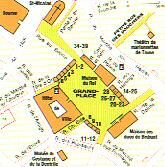 The
Grand Place, historical centre of Brussels is considered as one of the most
beautiful squares in the world. “La
plus belle place du monde” wrote Victor Hugo, “le plus riche theatre du
monde” said Jean Cocteau. The
Grand Place, historical centre of Brussels is considered as one of the most
beautiful squares in the world. “La
plus belle place du monde” wrote Victor Hugo, “le plus riche theatre du
monde” said Jean Cocteau.
It has the intemporal harmony, the architectural coherence, is an oasis
of quietness and perfection of a city that has treated its cultural inheritage
very badly too many times. The UNESCO added it in 1998 on the list of the sites
of world patrimony. What is evident that Cocteau and Victor Hugo could have used
some more literary imagination, really!!
In the 11th century swamps surrounded this area. The square became more and more important. Once a celebrations place and
expression of public power (scaffolds for the criminals). In the 13th,
wooden houses were built where rich bourgeois and merchants settled down. Town
Hall was built in the 15th century and a lot of guild houses
followed.
The wealth of its past is reminded to us as well by the venerable cobble stones
as by the gilded facades of the corporate houses, the gothic cross-barred
windows and medieval banners. This place was the scene of many events, markets,
insurrections, emperor celebrations, executions of scoundrels and popular
heroes.
 |
|
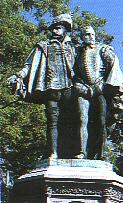
Counts Egmont and Horn |
In the 16th
Philip II of Spain who ruled over Belgium sent the duke of Alba to fight against
revolutionary Flemish nobility. The duke beheaded the rebellious counts of
Egmont and Horn in 1568.
Its most dark era was in 1695 when Louis XIV ordered the bombardment of Brussels
and the city turned into smoking ruins after three days. The whole square,
except a part of Town hall became an assemblage of ashes. More than 4000 houses
disappeared in the catastrophe. It was wild and useless. Didn’t Napoleon
declare much later:” This destruction was stupid”.
Only listening to their courage, the population retrieved their sleeves, spit in
their hands and started the rebuilding. After a few years the masterpiece, the
supreme of architecture you see now appeared on the square. Even more impressive
and grandiose.
The
Grand Place offers today the spectacle of Brussels daily life, with its cafes
and restaurants, numerous tourists taking pictures, the animation of cultural
events and festivals.
You could be content by a general view of the Place, admiring the different
architectural
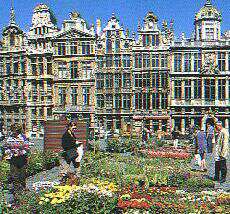 styles, gothic, neo gothic, Flemish Renaissance, Italiano-Flemish,
Louis XIV. If you look more closely you will discover a multitude of details
adding to the character and beauty of the scene. You should analyse façade by
façade. Sometimes the symbolism is
evident, sometimes you have to look for it. Every morning there is a little flower market and a bird market every
Sunday morning. Every 2 years around August 15, a magnificent begonia tapestry
covers the square (about 750,000).
110 m long and 68 m wide it is the heart of the city. styles, gothic, neo gothic, Flemish Renaissance, Italiano-Flemish,
Louis XIV. If you look more closely you will discover a multitude of details
adding to the character and beauty of the scene. You should analyse façade by
façade. Sometimes the symbolism is
evident, sometimes you have to look for it. Every morning there is a little flower market and a bird market every
Sunday morning. Every 2 years around August 15, a magnificent begonia tapestry
covers the square (about 750,000).
110 m long and 68 m wide it is the heart of the city.
Result? A square unique in its genre in the world. Which makes the French say:
“ Finally, if Louis XIV wouldn’t have bombarded the city, you wouldn’t
have such a magnificent square today.
We start next post with Town Hall.
|