|
Although much is heavily cultivated, other parts of
Burgundy are densely wooded. As well as the sores of natural watercourses, the
region boasts also many pretty canals. They were dug in the 18th
century when France was developing as an industrial power, but now the canals
are of little commercial value. The Rhine-Rhone canal connects Dijon with the
Rhine and the opening of the canal de la Marne à la Saone linked the region with
Paris. The Canal de Bourgogne, built between 1775 and 1834 winds it way through
Burgundy for 242 km and the Canal du Nivernais, which was completed in 1842,
meanders from the Yonne to the Loire.
Given Burgundy’s central location, the region naturally enjoys a continental;
climate with clear seasonal differences. It can be very hot in the summer. In
winter, though, it can be bitterly cold and a glass or two of something warming
is sometimes required. The weather fronts usually approach from the west, and if
the moisture-laden clouds on the way from the Atlantic are slow-moving, then
that invariably means a steady downpour in the geographical heart of the region.
In the southern department of Saone et Loire, however, spring often arises at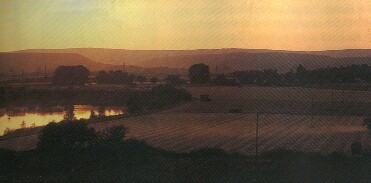 the end of February with blossoming vegetation and warm temperatures. But take
care in the hilly upland regions in Central Burgundy. Even in March the meadows
here will be covered with frost first thing in the morning.
the end of February with blossoming vegetation and warm temperatures. But take
care in the hilly upland regions in Central Burgundy. Even in March the meadows
here will be covered with frost first thing in the morning.
Burgundy makes an ideal year-round destination. In the depths of winter, many
hardy souls enjoy tours around the churches, monasteries, fortresses and
chateaux, although admittedly it is more fun in the warmer months. Autumn is a
very popular time of the year, as conditions are bright and sunny, but not too
hot for touring. However, morning mists may put a damper on some sightseeing.
Rainfall levels are highest in October (§and also May and June) but the changing
leaf color on the vines and trees creates a beautiful spectacle. At this time of
the year, the farmers are busy in their vineyards harvesting their precious
crop and on the Cote d’Or, in the Chalonnais, the Maconnais and Chablis, there
is much to be done. Anyone starting a tour in the Bourgogne in Dijon and then
heading south could be forgiven for thinking that every square yard of soil is
given over to wine production. Bur grapes are not the only crop.
Of all the French regions, only Corsica and the Limousin have a lower population
density. Almost half of the Burgundians depend on their soil against 26 percent
for whole France. Take now the Cote d’Or, not just a wealthy departement but
with the city of Dijon at its heart, relative densily populated. |