|
The old town of Dijon resembles a
medieval cobweb. Wealthy families used to live I n the splendid residences,
parliamentary presidents and religious dignitaries remind us that Dijon once lay
at the heart of a proud and fierce Empire. On a bright summer morning, as the
shouts of the market traders echo down the alleys, it is easy to imagine that a
glorious past lurks in practically every corner of this ancient town.
In the third century of the modern era, Dijon was established in an exceptional
environment of parks and gardens, just off the Via Agrippa and along the Amber
and Tin Road. At the heart of Dijon lies the semi-circular Place de la
Liberation, a vast open space, surrounded by columns in classical style which
date from the end of the 17th century. It was the work of Jules Hardouin Mansart,
the architect of Versailles. This brilliant court architect would probably turn
in his grave if he knew that his grand square was being used as a car park.
On the other side of the rue de la Liberté is the huge PALAIS DES DUCS ET ETATS
DE BOURGOGNE with its broad façade and two wings overlooking the Cour d’Honneur
courtyard. A Roman castle originally occupied this site, but between 1450 and
1455 the plain TOUR PHILIPPE LE BON was built on its foundations. The view from
the top (50 meters) extends among the rooftops of the old town and it is easy to
see why Dijon is sometimes called: “city of a hundred bell-towers”
Vestiges of this first chapter in the town's history can be seen in the
Archaeological Museum and in the courtyard of the Hôtel de Vesvrotte. The
mediaeval town, which grew up around the 3rd century military settlement, all
but vanished in the fire of 1137.
With the spread of Christianity came the creation of Saint-Etienne, the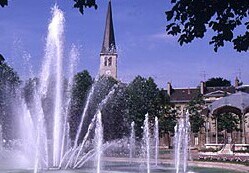 Franciscan friars and above all the impressive ensemble of Saint-Bénigne whose
church, with its three-storey rotunda, is a gem of Lombard architecture and the
work of the Piedmont master Gugliemo da Volpiano. The bewildering diversity of
half-timbered houses which visitors find so delightful developed between the
middle years of the 12th century and the end of the 15th century. With the dead
in 1477 of the last duke, Charles the bold, not only did the Burgundian Empire
come to an end, but Dijon also lost its fame and influence as a cultural center.
Not until the 18th century did the town’s star begin to wax again. Dijon became
the resident for a bishop and then the nobility and wealthy citizens chose to
build marvelous palaces for themselves there. Many of these buildings remain and
their dignified facades overlook the squares and streets in the heart of the
city.
Franciscan friars and above all the impressive ensemble of Saint-Bénigne whose
church, with its three-storey rotunda, is a gem of Lombard architecture and the
work of the Piedmont master Gugliemo da Volpiano. The bewildering diversity of
half-timbered houses which visitors find so delightful developed between the
middle years of the 12th century and the end of the 15th century. With the dead
in 1477 of the last duke, Charles the bold, not only did the Burgundian Empire
come to an end, but Dijon also lost its fame and influence as a cultural center.
Not until the 18th century did the town’s star begin to wax again. Dijon became
the resident for a bishop and then the nobility and wealthy citizens chose to
build marvelous palaces for themselves there. Many of these buildings remain and
their dignified facades overlook the squares and streets in the heart of the
city.
In the 19th century Dijon grew into an important commercial base through its
strategically
important location at the hub of waterways and then railways.
The 20th century was marked among other things by the construction of churches
in Dijon and its vicinity, and by an auditorium testifying to the cultural
vibrancy of a town attracting almost 25,000 students each year. |