Perigueux Perigord Dordogne in history Site Home - What's New? Feedback - About Jack- Travel/Art Links

Dordogne-Perigord
|
Perigueux Perigord Dordogne in history Site Home - What's New? Feedback - About Jack- Travel/Art Links |
|
|
|
Dordogne-Perigord |
|
Perigord -Perigueux in history (2) |
||
| back to Dordogne contents |
|
|
|
During the Augustean period the capital town, the town fell to the Romans, who called it Vessuna after a local spring, the Vésone that became their tutelary deity.
Vesunna was still in its first bloom when the barbarians crushed it in 275. Raped and pillaged into a stat of shock, Vesunna decide destroy its own temples and buildings for the stone and build a huge wall, contracting itself to the state of a small village. That’s why the modern town developed from two nuclei, the Cité and Puy-Saint-Front, which vied with one another until they united in 1251. The Cité, in the southwestern part of the town, occupies the site of Vesuna, subsequently reduced by the barbarians to the famous small encampment, called the Civitas Petrocorium, from which the names Cité and Périgueux are derived. Puy-Saint-Front, on the east, grew between the 5th and 13th centuries around an abbey sanctuary containing the body of St. Front, the Apostle of Périgord, and the first bishop of Périgueux. As the city declined a new village of artisans and merchants grew up around the nearby hill (puy) around the tomb of St. Front. St.Front evolved into no than a personal acquaintance of Jesus, who lived ion a perpetual state of virginity. He chased the devils and dragons out of the pagan temple of Vessuna by blasting an enormous breach in the walls. Périgueux
struggled against the English throughout the Hundred Years' Like I said in my previous post, the main point of cultural interest is the cathedral of Saint-Front, 12th century. One of the largest in southwestern France, it is built in the shape of a Greek cross, topped by five lofty domes and numerous colonnaded turrets. A Romanesque bell tower and cloisters of the 12th, 13th, and 16th centuries adjoin it on the south. Successive restorations, the last ending in 1901, have altered its original character. The Périgord Museum displays prehistoric and archaeological artifacts of the area, as well as secular and religious art. In the Cité is the 12th-century Church of Saint-Étienne, which was the cathedral until 1669. Evidences of ancient Roman occupation are an arena of the 3rd century AD, a boundary wall of the Roman civitas on which is built the Château Barrière (12th-15th century), and the Vésone Tower. Strollers will lose themselves in the alleys of Puy-Saint-Front displaying many legacies from Renaissance, the golden age of Périgueux, overlooked by its cathedral. The latter, often considered as a symbol of the town, has recently been listed by UNESCO among the sites that belong to "the World Heritage of Mankind", on the road to Santiago de Compostella. A bit further, as a hinge between XIX century quarters, the Musée du Périgord houses numerous treasures: prehistory, ethnology, medieval remains... Bibliography Périgueux oublié by Pierre Pommarède (1995)-Promenade dans Périgueux by Jacques Lagrange (1995)-Perigueux antique(2000) by Girardy-Caillat/Clau-Familles patriciennes de Périgueux á la fin du Moyen Age, by Arlette Higounet-Nadal-Promenade dans Périgueux by Jacques Lagrange (1995) |
||
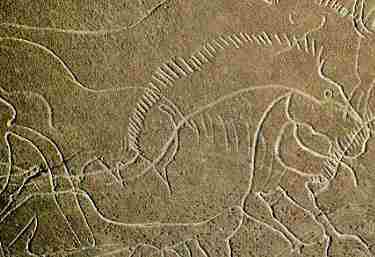 Vesuna,
which became Perigueux in later times, was founded in the valley. The town ran
along a low plateau and was smartened up during the years by many majestic
public monuments: amphitheatres, forum, and temple, public baths. Very luxurious
villas with refined decorations border on modest suburbs.
Vesuna,
which became Perigueux in later times, was founded in the valley. The town ran
along a low plateau and was smartened up during the years by many majestic
public monuments: amphitheatres, forum, and temple, public baths. Very luxurious
villas with refined decorations border on modest suburbs.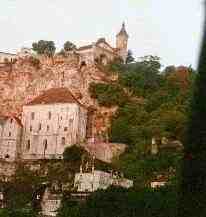 War (1337-1453) and suffered severely under Protestant occupation (1575-81)
during the 16th-century Wars of Religion, since it was a bastion or Catholicism.
Given amnesty by Louis XIV in 1654 for its part in the Fronde (a series of civil
disturbances, 1648-53), the town then experienced an era of peace. At the time
of the French
War (1337-1453) and suffered severely under Protestant occupation (1575-81)
during the 16th-century Wars of Religion, since it was a bastion or Catholicism.
Given amnesty by Louis XIV in 1654 for its part in the Fronde (a series of civil
disturbances, 1648-53), the town then experienced an era of peace. At the time
of the French 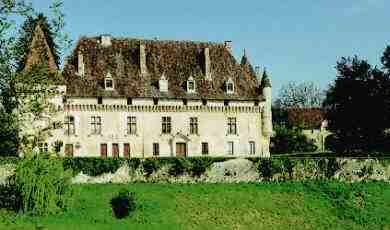 Revolution
at the end of the 18th century, it continued as the capital of a département,
covering the same area as the medieval province of Périgord Blanc. From the
July Monarchy (1830) onward many improvements were made, and the town received
new impetus under the Second Empire (1852-70) and the Third Republic
(1870-1940).
Revolution
at the end of the 18th century, it continued as the capital of a département,
covering the same area as the medieval province of Périgord Blanc. From the
July Monarchy (1830) onward many improvements were made, and the town received
new impetus under the Second Empire (1852-70) and the Third Republic
(1870-1940).