|
Back to Languedoc main page
The
Cathar
country
part 1
The
Cathar country part 2
The
Cathar country part 3
The
Cathar country part 4
|
In 1210, MINERVE is besieged by the crusaders. At the other side of the ravine an enormouscatapult is positioned to throw huge rocks in the gaping depth, destroying all draw wells of the little city. Summer, heat and drought did the rest: Minerve had to yield and the heretics extradited to the enemy. More than 140 Cathars were lead, a rope around the neck over the small cobblestones of the rue des Martyrs towards the southern gate. A steep path leads to the ravine, where they were all burned at the stake.
 |
|
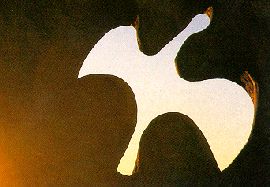
Peace dove |
Today, next to the church which was a witness to the tragedy,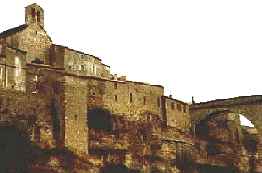 you can see a memorial, a rock piece carved out in the middle in the form of a peace dove, letting the blue light of the sun shine through. That's the way the artists wanted to represent the "god of the light" of the Cathars. It became the symbol you can see everywhere in this country and region. Left to the memorial stands an iron cross, symbol of that other belief, the god they called the devil. It's strange to see them both here, side by side, as if they made up with each other. you can see a memorial, a rock piece carved out in the middle in the form of a peace dove, letting the blue light of the sun shine through. That's the way the artists wanted to represent the "god of the light" of the Cathars. It became the symbol you can see everywhere in this country and region. Left to the memorial stands an iron cross, symbol of that other belief, the god they called the devil. It's strange to see them both here, side by side, as if they made up with each other.
In the middle of the Montagne Noire, in a densely forested region with waterfalls and steep ravines, a small hiking path surges above the highest row of a tribune. The view is so breathtaking that I walk without even looking where I put my feet, until I reach a sort of podium, not letting my eyes off the beauty around me. Ruins of four castles are laid out on the summits of several mountains, is if an artist painted them with a tremendous feeling for composition. Here and there, cypresses grow on the slopes and I know now for sure that this must have inspired a lot of people to start a book about the Cathars and their country. Here, in this resistance foyer against the crusade, love will grow between a Cathar girl and a crusader. An impossible love, worth a Romeo and Juliette drama, since the differences are too big and the circumstances too difficult. ravines, a small hiking path surges above the highest row of a tribune. The view is so breathtaking that I walk without even looking where I put my feet, until I reach a sort of podium, not letting my eyes off the beauty around me. Ruins of four castles are laid out on the summits of several mountains, is if an artist painted them with a tremendous feeling for composition. Here and there, cypresses grow on the slopes and I know now for sure that this must have inspired a lot of people to start a book about the Cathars and their country. Here, in this resistance foyer against the crusade, love will grow between a Cathar girl and a crusader. An impossible love, worth a Romeo and Juliette drama, since the differences are too big and the circumstances too difficult.
I see a lot of tourists and they are all climbing to one of the four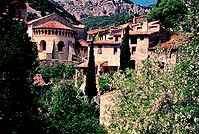 towers or just descending from them. They toil and moil all over the paths, up and down, over the rock heaps, look through the holes of the remaining walls, shout at and mock their fiends down in the valley who didn't have the courage to make the climb. Those take pictures. A group of young Spaniards settled down near a cypress wood. One of them has a guitar, on which he twangs a few notes. The towers frown upon all this, they have seen much worse in the past. Knights and soldiers, riding out in the night, harassing the enemy with sabotage actions and ambushes, attacking convoys to rob the crusaders of their weapons and food supplies. towers or just descending from them. They toil and moil all over the paths, up and down, over the rock heaps, look through the holes of the remaining walls, shout at and mock their fiends down in the valley who didn't have the courage to make the climb. Those take pictures. A group of young Spaniards settled down near a cypress wood. One of them has a guitar, on which he twangs a few notes. The towers frown upon all this, they have seen much worse in the past. Knights and soldiers, riding out in the night, harassing the enemy with sabotage actions and ambushes, attacking convoys to rob the crusaders of their weapons and food supplies.
If you continue your travel through Cathar country, southwards from the Montagne Noire, you will cross the Autoroute des Deux Mers, and soon enter the village of Las
Mas-Saintes-Puelles.
Bibliography
Wonderful Cathar Country, by J. L. Aubarbie (Editions Ouest France, Rennes, 1994), The Albigensian Crusade, by Bernard Hamilton(Historical Assoc., London, 1974), Ecritures Cathares: textes preCathares et Cathares, by Rene Nelli, Rene(Paris, 1968), The Perfect Heretics: Cathars and Catharism, by Jeff Merrifield, (Enabler Publications, Dorset,1995, Le Catharisme, by Deodat Roche (Toulouse, 1947)
|