|
The city of Blois is build
as an amphitheatre on the slopes that overlook the Loire and invites the
loiterer –as well as the architecture passionate—to explore the maze of its
medieval street. It was heavily
damaged during the war. The new constructions were laid out in a manner to clear
perfectly the view of the chateau. But the typical French atmosphere is to find
mainly in the OLD QUARTIERS: the ancient, tortuous streets, climbing
capriciously the scarped slopes of the river shore like the rue Pierre de Blois,
du Chant-des-Oiseaux, the rue du Puits-Chatel and rue des Papegaults. Also
the rue Rebrousse-Penil, pedestrian, joining the rue du Commerce: adorable
passage under a house. Admire also the place Saint-Louis with its beautiful old
houses. Loiter around the porte Chartraine, porte Cote and the lively rue Denis
Papin (the inventor of the steam machine), a son of this city. Also the
illusionist Louis-Eugene Robert Houdin was born here and lived here (the city
financed a "House of Magic Robert Houdin”). If you want guided visits of
the old Blois take info at the chateau tel 0254741606.
Blois, actual capital of the Loir-et-Cher was, was, after all, the centre of French
Renaissance. Look at the prestigious chateau, where most important events of
French history were plotted. Louis XII, king of France in 1498, was born here
in1462.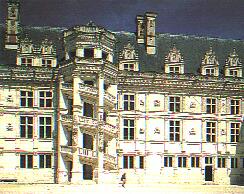
Let's start the visit of the chateau.
The architecture of the chateau de Blois covers 4 centuries of tormented history
of the town. A journey that starts in the 13th century, after the
counts of Blois had given their freehold to the king of France, continuing with
the royal grandeur of Renaissance art and the murderous hours of religion wars
to end with much quieter times but much richer in conspiracies, of Gaston
d’Orleans in the 17th century.
The chateau is built on a slope in
full centre town, and takes the form of a quadrilateral surrounding an honour
courtyard. The exterior façade shows a medieval part, recognisable because of
its pointed roof, it houses the salle des “Etats Generaux” (13th
century) with 2 woodwork-covered naves. A more modern one, nicely build in stone
and bricks built under Louis XII (1498) which equestrian statue stands in the
main porch. Crossing the interior courtyard, go 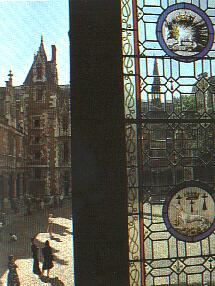 to the terrace overlooking the
Loire and the last vestige of the medieval remnants: le Tour de Foix. Come back
in the courtyard and admire the gothic choir of the chapelle Saint-Calais,
private chapel of Louis XII. Certain sculpted personages (1st and 4th windows,
left of the entry) remind us of the to the terrace overlooking the
Loire and the last vestige of the medieval remnants: le Tour de Foix. Come back
in the courtyard and admire the gothic choir of the chapelle Saint-Calais,
private chapel of Louis XII. Certain sculpted personages (1st and 4th windows,
left of the entry) remind us of the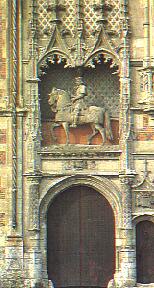 Rabelaisian smutty stories of that era. At
the end of the interior courtyard a famous staircase is enclosed in an octagonal
tower equipped with balconies and decorated with marvellous sculptures from
where the courtesans could follow the ceremonials. Rabelaisian smutty stories of that era. At
the end of the interior courtyard a famous staircase is enclosed in an octagonal
tower equipped with balconies and decorated with marvellous sculptures from
where the courtesans could follow the ceremonials.
First floor, the salle des Gardes,
where Ronsard met Cassandra, and the cabinet of the famous Catherine de Medicis
where this intriguing woman who was the mother of three kings of France, kept
her personal papers, jewels and a collection of poisons hidden in mural
cupboards opening with a secret mechanism The guide will show the cupboard of
poisons that was opened by pushing with your foot on a device hidden in the
plinth! At the 2nd floor, the apartments of Henri III. Here, the Duke of Guise
was assassinated and died in the king's room. It
gave Henri III the opportunity to get rid of one of his most heavy opponent. The
guide will precise to the visitor the exact spot where 23 knife stabs were
planted in the unfortunate duke by 8 men armed with daggers and 12 with swords!
In those times they had the style of well-done work!;-).This Duke de Guise was
the head of the Catholic League, supported by Spain. His murder was one of the
most dramatic episodes of the religion wars. More in next article....
Bibliography
Regions Gourmandes: Les pays de la Loire, by
H.Walden (Paris, ed.Hatier 1993)—Guide du Patrimoine, Centre, Val de Loire ,
by Perouse de Montclos (ed.Hachette 1992)—Het dal van de Loire, by A.Sperber
(Brussels, ed.Harenberg 1992)—Par les champs et par les greves, by G.Flaubert
(1885)—Guide du Routard 1998 (ed.Hachette)—de kastelen van Frankrijk, by
L.P.Boon (1956)-Histoire tourmentee de Blois, by J.P.De la Rue (ed.La Cité 1995)
|