Blois, chateau de la Loire Visit city Site Home - What's New? -Feedback - About Jack- Travel/Art Links

Loire Valley
|
Blois, chateau de la Loire Visit city Site Home - What's New? -Feedback - About Jack- Travel/Art Links |
|
|
|
Loire Valley |
|
Loire valley-Chateau de Blois-Rest of city |
|||
|
City, history, begin visit chateau
Chateau and rest of city
|
|
||
|
The city of Blois is build
as an amphitheatre on the slopes that overlook the Loire and invites the
loiterer –as well as the architecture passionate—to explore the maze of its
medieval street. It was heavily
damaged during the war. The new constructions were laid out in a manner to clear
perfectly the view of the chateau. But the typical French atmosphere is to find
mainly in the OLD QUARTIERS: the ancient, tortuous streets, climbing
capriciously the scarped slopes of the river shore like the rue Pierre de Blois,
du Chant-des-Oiseaux, the rue du Puits-Chatel and rue des Papegaults. Also
the rue Rebrousse-Penil, pedestrian, joining the rue du Commerce: adorable
passage under a house. Admire also the place Saint-Louis with its beautiful old
houses. Loiter around the porte Chartraine, porte Cote and the lively rue Denis
Papin (the inventor of the steam machine), a son of this city. Also the
illusionist Louis-Eugene Robert Houdin was born here and lived here (the city
financed a "House of Magic Robert Houdin”). If you want guided visits of
the old Blois take info at the chateau tel 0254741606. Bibliography Regions Gourmandes: Les pays de la Loire, by
H.Walden (Paris, ed.Hatier 1993)—Guide du Patrimoine, Centre, Val de Loire ,
by Perouse de Montclos (ed.Hachette 1992)—Het dal van de Loire, by A.Sperber
(Brussels, ed.Harenberg 1992)—Par les champs et par les greves, by G.Flaubert
(1885)—Guide du Routard 1998 (ed.Hachette)—de kastelen van Frankrijk, by
L.P.Boon (1956)-Histoire tourmentee de Blois, by J.P.De la Rue (ed.La Cité 1995) |
|||
n 1843 Prosper Merimee, a
famous French writer and also monuments inspector declares the chateau de Blois
as a historical monument and ordered a full restoration. In 1990, during new
restoration works a terrace by Mansart was discovered. To preserve the chateau
for the new millennium, visitors are required to behave properly, since every
year they still have to scratch 1200 pieces of chewing gum off the floors!
The chateau de Blois houses also the FINE ARTS MUSEUM in the Louis XII wing.
Nearly 300 works covering the period going from the 16th to the 19th century:
French paintings and sculptures, Flemish, Italian, portraits, iron works. Also a
remarkable painting by Charles Durupt about the murder of Henri de Guise.
Prehistorical and medieval findings are kept in the archaeological museum.
In the evening, you have a fairy-like view on the castle from the square
downward. The balconies and arcades are lightened from the inside.
In front of the castle, place du Chateau, the HOUSE OF MAGIC ROBERT
HOUDIN was opened in 1996 with objects, documents and posters showing us the
world of Magic. Part of the collection comes
from Jean-Eugene Houdin (1805-1871), born in Hungary, naturalized
American who took the nickname Harry Houdini.
He actually lived in Saint-Gervais, 3 km south of Blois.
On the roof, the famous mysterious clock, invented by Houdin, functioning
without apparent mechanism. In the first basement you enter in the universe of
magic with holograms, videos and collection objects that belonged to Houdin. In
the second basement, the whole story of the celebrated magician and films of
Melies, director of his Soirees Fantastiques.
The spectacle hall is the only one in the world totally pre-equipped for
magic. Sometimes weird things cross the room: fake theatre boxes, disappearing
spectators.
At the ground level a boutique gives you the opportunity to buy some
magic devices and tricks to scare off mom or grandma.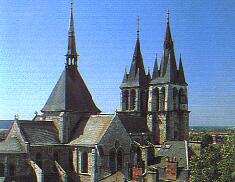
“”Is it a book of Balzac that made me think of the streets of Blois and
about what happens there, or is it what happened there that was the cause of
this book?”” extr.of “Along the Loire “ by Gustave Flaubert. A stroll in
the OLD BLOIS will lead you to the eglise SAINT-NICOLAS, for me much nicer than
the cathedral. Ancient abbey church built in the 12th and 13th century, in roman
and gothic style. Notice when
inside the form of the choir, and the curious stained-glass windows, almost
surrealistic.
To finish with Blois a few words about the cathedral SAINT-LOUIS. Certainly not
a jewel rebuilt in neo-gothic after its destruction by a hurricane in the 17th
century.
Bibliography
Regions Gourmandes: Les pays de la Loire, by H.Walden (Paris, ed.Hatier 1993)—Guide du Patrimoine, Centre, Val de Loire , by Perouse de Montclos (ed.Hachette 1992)—Het dal van de Loire, by A.Sperber (Brussels, ed.Harenberg 1992)—Par les champs et par les greves, by G.Flaubert (1885)—Guide du Routard 1998 (ed.Hachette)—de kastelen van Frankrijk, by L.P.Boon (1956)-Histoire tourmentee de Blois, by J.P.De la Rue (ed.La Cit 1995)
 to the terrace overlooking the
Loire and the last vestige of the medieval remnants: le Tour de Foix. Come back
in the courtyard and admire the gothic choir of the chapelle Saint-Calais,
private chapel of Louis XII. Certain sculpted personages (1st and 4th windows,
left of the entry) remind us of the
to the terrace overlooking the
Loire and the last vestige of the medieval remnants: le Tour de Foix. Come back
in the courtyard and admire the gothic choir of the chapelle Saint-Calais,
private chapel of Louis XII. Certain sculpted personages (1st and 4th windows,
left of the entry) remind us of the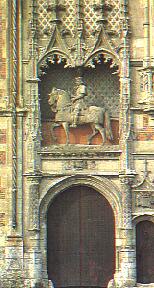 Rabelaisian smutty stories of that era. At
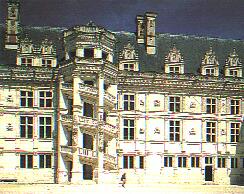
the end of the interior courtyard a famous staircase is enclosed in an octagonal
tower equipped with balconies and decorated with marvellous sculptures from
where the courtesans could follow the ceremonials.
Rabelaisian smutty stories of that era. At
the end of the interior courtyard a famous staircase is enclosed in an octagonal
tower equipped with balconies and decorated with marvellous sculptures from
where the courtesans could follow the ceremonials.