|
Tours contents
Introduction
ad how to get there
History,
part 1
History,
part 2
|
Turones, a small hamlet of
the Gallic tribe of the Turons, developed under Roman rule to the wealthy "Caesarodunum"
(the hill of Caesar). This wealth came to an abrupt end in the 3rd
century with the barbaric invasions since the village didn't have any ramparts
and was very unsecured suffering also from the caprices of the Loire. The
village became very small but to defend the fortress in the future,
fortifications are set up in the 4th century, which have still some remains near
the chateau and the cathedral.
But Christianity was on the move and the pope nominated the first archbishop,
saint Gatien. This fact would settle once and for all the brilliant future of
Tours in the centuries to come of the regions of Touraine, Maine, Anjou and even
Bretagne. It started already in the 4th century with the building of
a church, intra muros. But it is under the episcopate of Saint Martin (371-397)
that Christianity exploded. He
ordered the destruction of all pagan idols and temples and when he dies in 397,
it's on his tomb that the first basilica is build.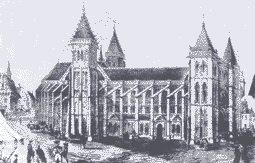
The next centuries, especially in the sixth will se Tours grow as a very
important city. Clovis, who was king of the Francs at that time came often to
the St.Martin shrine in Tours to pray for victory against the Visigoths and
annex the Aquitaine. And he came not alone! Huge crowds came already from all
over to render grace to the famous saint, to get a miracle or just out of
curiosity. The Lourdes of that era!! Of course a lot of visitors means a lot of
money and is good for the economy. Presents and donations (in hard cash!) flowed
easily in the basilica boxes, which had become an abbey in the mean time, so it
could extend. Two centuries after saint-Martin, another bishop, Gregoire, made
Tours famous by writing a book "L'Histoire de Francs", still a
reference today for the French monarchy historians. Tours had this aura of
spirituality and luxury in the 7th and 8th century, which excited the curiosity
of the (quote): Arabs who decided to make a little excursion (!!), just a matter
of see what there was to carry off that mythic city. But.......as any school boy
and girl of the lower grade in France knows today:"
Charles-Martel-defeated-the-the -Arabs-in-Poitiers-in-732". Very good,
Jean, you will have an A. I figure they still learn that in school, even if the
latest historical studies conclude that several locations could have been the
battlefield and mostly more in the suburbs of Tours than in Poitiers! Anyway,
exit the Arabs who will never take Tours. (unquote)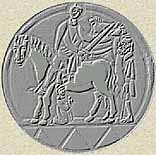
The Anglo-Saxon monk Alcinius from York settled down in Tours at the demand of
Charlemagne in the 8th century where he soon became the driving power
of the Carolingian Renaissance. He
did all he could to elevate the quality of the schools. Becoming the abbey of
St.Martin de Tours in 796 he reformed school education that soon became very
reputed for the quality of its calligraphy and colored prints. Students came
from all over Europe to study here. They will realize the famous Alcuin Bible
and set the nucleus or the future world known university of Tours.
Suite in next article
History 2.....
Bibliography
Regions Gourmandes: Les pays de la Loire, by
H.Walden (Paris, ed.Hatier 1993)—Guide du Patrimoine, Centre, Val de Loire ,
by Perouse de Montclos (ed.Hachette 1992)—Het dal van de Loire, by A.Sperber
(Brussels, ed.Harenberg 1992)—Par les champs et par les greves, by G.Flaubert
(1885)—Guide du Routard 1998 (ed.Hachette)
—de kastelen van Frankrijk, by L.P.Boon (1956)
|
Loire
main page
WalkTours-CathedraleSaint-Gatien
Walk Tours-Chateau- Musee
Beaux Arts and others
Walk
Tours-Place Plumereau - Musee du Gemmail
|