|
 According
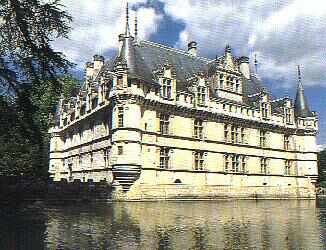
to Balzac, this marvel and miracle of a chateau de la Loire is like a
refined polished diamond. I agree, diamonds are my job ;-). He even
added: " diamond polished with thousand facets, set in the
Indre" It seduces us not only by the grace and purity of its style
(Tourangelle Renaissance), but also by its human and welcoming
dimension. Despite the tourists, like in Chenonceau, are very busy
photographing by thousands! According
to Balzac, this marvel and miracle of a chateau de la Loire is like a
refined polished diamond. I agree, diamonds are my job ;-). He even
added: " diamond polished with thousand facets, set in the
Indre" It seduces us not only by the grace and purity of its style
(Tourangelle Renaissance), but also by its human and welcoming
dimension. Despite the tourists, like in Chenonceau, are very busy
photographing by thousands!
Like Chenonceau, this chateau was born thanks to the initiative of a
woman, the spouse of financier Gilles Berthelot.
Like most of its sisters in the Tours region, Azay-le-Rideau has a long
history, moreless eventful: before becoming the peaceful country estate
that you can visit today, the previous chateau was a medieval fortress
with solid ramparts. The’ waters of the Indre are not anymore
defensive obstacles but water mirrors where the gracious silhouette of
the chateau reflects for our pleasure. The corner turrets coquettishly
rounded house the bedrooms and music-rooms, abandoning their defensive
role of shooting arrows and pour boiling oil. The ramparts are
transformed to a friendly collar embracing the castle and never a guard
walked around the path all along the decorative balustrade of the roofs.
But the marvels of this chateau cannot delete the massacre that took
place here in 1418.
The future king Charles VII, who was 15 years old at the time, returned
to Chinon via Azay.A Burgundian garrison that was settled in Azay
insulted our poor little prince at his passage---I'm very curious about
what they said to him! ;-)----. Charles VII got very mad and gave the
order to exterminate the 350 Burgundian soldiers and burned the chateau
and the village down to the ground. They had it coming, na!!
During at least two centuries, the city will keep from this violent
souvenir the name of “Azay-le-Brulé”’.
|
|
|
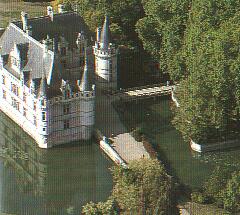
Aerial view (scanned from
brochure) |
The chateau was
rebuilt in elegant early Renaissance style from 1518 on the ruins of the
ancient castle by the wife of Gilles Berthelot (I told you already about
in my introduction), mayor of Tours and president of the Chambre des
Comptes (kind of official Finance office). But the works were
interrupted in 1527when her cousin, Jacques de Beaune-Semblancay,
finance minister of Francois 1er was executed, the whole Berthelot
family feared for her safety and left the region in a big hurry and
lived abroad until the death of Gilles Berthelot in 1529.. The king
seized the chateau and gave it to one of his war friends, Antoine
Raffin. And finally in 1787 it belonged to the marquis the Biencourt,
that the works will restart and the building continued. Beginning 20th
century, the last marquis, totally ruined had to sell the chateau to the
French state.
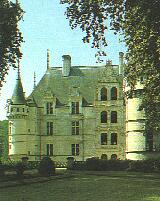
The result of the rebuilding is surely different from the initial plan.
One could swear there is a wing missing on the left side!!
Even details, usually associated with the severity of military
architectures, like machicolations, "chemins de ronde", etc..
are transformed as touched by a magical wand, in decorative elements of
the most elegant effect. Make the tour around (outside) of the chateau
to see this beautiful spectacle. Inside you will particularly appreciate
the kitchens with its beautiful vaulted ceiling. The halls and galleries
are nicely decorated by Renaissance furnishing like this magnificent
Spanish travel cabinet (160 pounds!) of the 16th century ivory incrusted
and another, Portuguese, of the 17th century, Flemish tapestries, and an
oak baldachin throne of the 15th century. Don’t miss the admirable and
impressive stairway, richly decorated.See the monumental open fires.
Admire in the blue room, on the second floor, the delicate bed of the
18th century in unachieved silk embroideries.
 Practical info for
visiting the chateau Practical info for
visiting the chateau
------------------------------------
Open April 1 to end of June and September to end October 9.30-18.
Open July and August 9.30-19
Open November 2 to end March 9.30-12.30 and 14.00-17.30
Closed on January 1, May 1, November 1 and November 11, December 25.
Entrance fee: 32 FF (reduction for children)
The visit is free, guided or with audio-guide (supplement).You have a
spectacle-promenade (60 FF) every night from mid-May to Mid -September
22.30 to 0.30 (21.30 to midnight in September)
Bibliography
Guide du Patrimoine,
Centre, Val de Loire , by Perouse de Montclos (ed.Hachette 1992)—Het
dal van de Loire, by A.Sperber (Brussels, ed.Harenberg 1997)—Guide du
Routard 1998 (ed.Hachette)—de kastelen van Frankrijk, by L.P.Boon
(1956)-La Terreur en 1418, Charles VII, by Ch .de la Maurienne
(Livtours 1986)-Les Perles de la Vallee du Loire, by P.Paulars (short
descriptions in small folders, Tours 1995)
|