|
Fecamp in Normandy Site Home - What's New?-Feedback - About Jack-Travel/Art Links |

NORMANDY-Fecamp
Fecamp
Pays d'Auge, Calvados, Camembert and Cider
The D 940 continues north
from Etretat to FECAMP. You can also follow the D 11, which will lead you very
close along the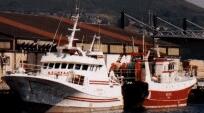 seaside through adorable fisher ports. But Fecamp is the purpose of this
article.
seaside through adorable fisher ports. But Fecamp is the purpose of this
article.
Fecamp started as an abbey in 658. After the invading Normans destroyed the
abbey, it climbed hierarchy very fast and the small fisher port was even for a
moment the capital of Normandy in the 10th century. The dukes, being very
generous to the monks of the abbey, it generated some interesting building, the
more that the monks knew how to exploit the dukes piety. From the 16th century
on, Fecamp was homeport to a lot of fisher boats, sailing to New Foundland, a
paradise for cod-fishing.
In fact, Fecamp has two parts: the actual harbour with sailor cafes with the
church of Saint-Etienne, and the higher located old city where the merchants and
ancient families lived, with the cloister and Eglise Sainte-Trinité (abbey
church) as center. The 22,000 inhabitants of Fecamp are proud to have a
kilometres long pebble beach and is now one of the most loved tourist spots on
the Cote d’Albatre.
 |
|
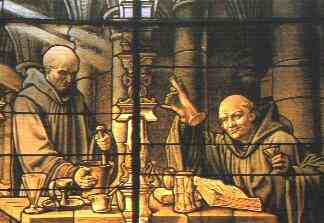
Monks and Benedictine |
Not only cod made Fecamp
famous but also this amber liquid we call “Benedictine”, produced in a
building you might be forgiven for confusing it with the abbey. It is a
distillation of 27 plants and spices, invented by a monk, Dom Vincelli, lost
during centuries but found back in 1863 and brewed again in the “Distillerie
Benedictine”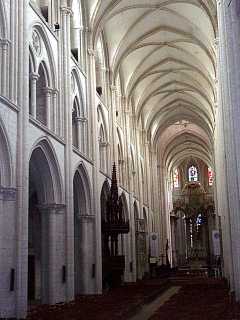
Let’s visit his monastery SAINTE-TRINITE. It’s sitting at the spot
where the trunk of a fig tree was washed ashore with a vessel containing blood
from the wounds of Christ, concealed inside it. Built in 1220, it is a most
impressive church of cathedral-like proportions, has a treasure house of early
stained glass, altarpieces, tombs, carved screens and a tabernacle containing
relics of the Precious Blood. It has different building styles, because it burnt
down at certain epochs and parts were built again. These different styles are
explained on a panel near the entrance.
In the rue Alexandre Legros, a busy street, the MUSEE CENTRE DES ARTS, is house
in a beautiful 19th century hotel particulier. Porcelain, faience, paintings and
extraordinary ivory objects are on display.
Along the seaside you can also visit the MUSEE DES TERRE NEUVAS ET DE LA PECHE,
a modern building of two stories, dedicated to the New Foundland fishers and
their history.
For a side trip you can drive, south of Fecamp, to the 16th century CHATEAU DE
BAILLEUL, where only the sculpture garden and park is open for visits. On a high
cliff, a chapel, Notre-Dame-de-Salut, with an incredible panorama on Fecamp and
the cliffs to the south. You can see a plaque o the wall, in souvenir of the
sailors who perished in 1986 in the shipwreck of the Snekkar Artic . Not far
from there, ain the hamlet St. Leonard, you can stay overnight in a luxury room
of the “Auberge de la Rouge”, which restaurant is quite famous.
Bibliography
"Region Normandie, ses merveilles, ses cicatrices", by Louis Letellier
(ed. Cloison, Rouen 1995, "Claude Monet : impressions of France : from Le
Havre to Giverny" by John Russell Taylor, "Le peuple du Havre et son
histoire" by Jean Legoy, "Hoog Normandie" by Sandra Vermoolen(
ANWB reisgidsen,Den Haag)- "La Haute-Normandie autrefois" by
Nadine-Josette Chaline.