|
Cabourg Dives sur mer Normandy Site Home - What's New?-Feedback - About Jack-Travel/Art Links |


NORMANDY
Cabourg-Dives sur mer
Pays d'Auge, Calvados, Camembert and Cider
 |
|
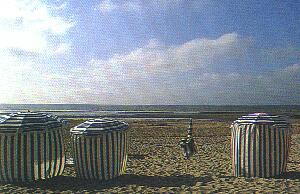
Cabourg plage |
The idea to make a resort out of CABOURG was launched in the 19th century by a few tycoons. The investors tried to attract tourists like the neighbouring Trouville) and they succeeded. Soon CABOURG was THE trendy place to go for mundane people. Marcel Proust made it famous throughout the world.
 |
|
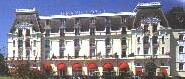
Grand Hotel Cabourg |
He spent his summer holidays here from 1907
up, in the Grand Hotel, a great cream mansion that dominated the main square. He wanted to be left alone for his writing, therefore he rented all rooms surrounding his. You should go and visit the marbled, pillared hall and chandelier-dripping lounges, even for a cup of coffee, while serious gastronomes may head for the hotel's BALBEC restaurant looking over the sea, which Proust called the "aquarium" in his life work " A la recherché du temps perdu".
Cabourg, a one-shopping street town has fine examples of the 19th and early 20th century chateau-on-sea architecture, incorporating steep gables, slate roofs, tall chimneys and the fanciest finials you could
find.
 |
|
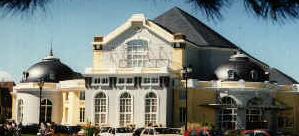
Cabourg Casino |
Sportsmen have everything they want, even too many possibilities.
But the glamour has begun to fade, and next door to the Grand Hotel, the Casino has been undergoing restoration.
Just outside Cabourg, squeezed between it and Houlgate is the charming little town DIVES-SUR-MER. It has a lot more historical valour since it's here that William the Conqueror (also called the Bastard) prepared his fleet in 1066 to invade England. 55,000 soldiers and mote than 700 boats!! Imagine.
He wouldn't recognize it today. Sea has withdrawn more than 2 km, and where the small bay from where the boats departed are now full of grazing
cows! 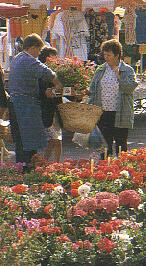 The historic town is wonderful but in addition to this the
water front Marina has been recently refurbished (according to Mr. Tim
Edwards). For a recommended tea parlour from Mr. Ewards see my restaurant
recommendations.
The historic town is wonderful but in addition to this the
water front Marina has been recently refurbished (according to Mr. Tim
Edwards). For a recommended tea parlour from Mr. Ewards see my restaurant
recommendations.
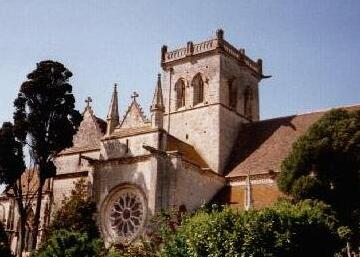
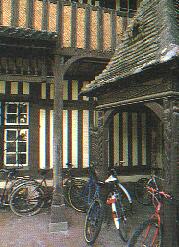 Today Dives greatest attraction is the very lively market hall complex (500 years old) called Les Halles. An impressive oak construction in three parts. The church Notre-Dame, in the rue Boucher, is another eye-catcher. Built as a thanksgiving by William in 1067. It's an admirable edifice, containing religious relics washed ashore with miraculous regularity in the 10th and 11th century. The church went trough several restorations and today, with flying gargoyles characteristic of the 14th-15th century local Gothic churches, it has a tumbledown air, and sparrows call out
from its fan-vaulted aisles.
Today Dives greatest attraction is the very lively market hall complex (500 years old) called Les Halles. An impressive oak construction in three parts. The church Notre-Dame, in the rue Boucher, is another eye-catcher. Built as a thanksgiving by William in 1067. It's an admirable edifice, containing religious relics washed ashore with miraculous regularity in the 10th and 11th century. The church went trough several restorations and today, with flying gargoyles characteristic of the 14th-15th century local Gothic churches, it has a tumbledown air, and sparrows call out
from its fan-vaulted aisles.
Entering the church, raise your head: You'll see the 500 names of the financiers and companions of William the Conqueror exploits. Only the nave is roman, dating 11th century, other parts are flamboyant gothic (14th) or late gothic (15-16th). Near the choir you can see a hole in the wall: dug in the 14th century to accommodate the leprous to follow the services without bothering no one.
Opposite the church is the Michel Dupont chocolatier with a salon de the.
 |
|
Eglise Dives sur mer |
Another old building next to the Halles between the rue Hastings and the rue de la Baronnie is the "Lieutenance", residency of the duke of Falaise, which was restored in 1920 when the rest of the buildings in the square were torn down. Also not far from the Halles, an enfilade of small shops, restaurants, antique dealers and craftsmen, in a very agreeable medieval atmosphere: the art village of William the Conqueror. But let's face it, it is a tourist trap.
Dives port today lies around a collection of small fishing boats on the quay beside the river, left roped to the wall when the tide goes out. On sale are live pink crabs and grey shrimps and mussels by the litre, freshly caught the previous night.
Bibliography
A holiday history of France, by Ronald Hamilton (London-Hogarth press), Region Normandie, ses merveilles, ses cicatrices, by Louis Letellier (ed. Cloison, Rouen 1995, La France des petits chemins: Normandie, by J. de la Valléé (ed. Cité presse, Paris 1998), Identity of France, by Fernand Braudel (London, Fontana Press).