|
From Saint-Remy to Fontvieille via Les Baux de Provence we
will get lost in this pale white rock paradise, one of the most spectacular
wonders of nature of France, we will walk though a “typical” village like
Fontvieille and we will climb the Montmajour, an abbey ruin where Van Gogh was
so enthusiastic about. Then we will visit the magnificent ruins of Barbegal, the
only remains in the world of a mill that was driven by water force.
|
|
|
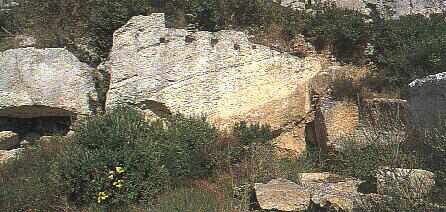
Les Baux-east side |
About LES BAUX-DE-PROVENCE with its surrounding valleys
full of rests of stone groves as high as cathedrals and hollow spaces packed
with bats and holes to fall inside, immense libraries have been already written
and filled.
|
|
|
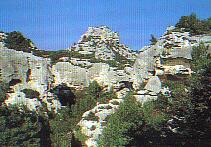
Val d'Enfer |
It’s worth, before entering Les Baux, to stay a little
while on the D 27 and descend to one of the stone quarries along the col de
Sarragan—short before the descent to the “VALEE DES ENFERS”--. In one of
them a clever merchant opened a wine tasting places of gigantic proportions; in
another a “cathedrale d’images” where Jean Cocteau made some scenes of his
movie picture “Le Testament d’Orphée”.
This “Cahedrale d'Images"
was created by Albert Plecy in 1977. In
immense underground halls (ancient limestone quarries) you walk between images
projected all the time and continually renewed . Take some sweater or something
to cover with you, the corridors are chilly!
Readers who are no fearing sportsmen can descend into the
"Val d'Enfer" discover an impressive site, seen from the bottom (near
the hotel-restaurant De Baumaniere--beware! Don't enter there unless you're
very, very wealthy) and notice the houses build leaning on the rocks, and even
inside the rocks (descending the road leading to the Benvengudo).
LES
BAUX-DE-PROVENCE is a unique site. Looking if it was grown together by
her form and colour with the Alpilles range, it is seems as inaccessible as in
its glorious days. Being deserted for centuries Les Baux is now—thanks to the
tourist industry—“a vivid, lively dead city”, but still a ghost of the
past. Bursting out of the scrub, this vast eagle's nest is almost completely dismantled
today. You have magnificent views, when the sky is clear and without fog,
far beyond the Alpilles, to the Cevennes!! An anecdote assures that it is here
that Dante conceived his idea to write "La Divina Commedia".
The legend says that Balthazar, one of the three wise men
from the east, who followed the star of Christ, met a shepherdess. He promised
to marry her and to build a palace for her at the peak of the white rock. He did
it and there was the castle. But the history of Les Baux goes back to the
Celto-Liguric tribes long before BC, who picked this 280 m high rocky place for
their sacred relics. In their Celtic language, "bau" means
"scarped rock" and therefore the name today. In the 11th century the glorious lineage of the masters of Les
Baux started. They ruled over 72 cities and villages and were always at war,
like a sport. They were feared by the French kings. Their castle at the top of
the rock was reputed as inexpugnable. The city became one of the main love
courts of medieval times: the domain for tournaments, court manners and
troubadours. In 1372, power was taken by Raymond de Turenne. Soon he got his
nickname “the yellow curse of Provence” since his took his pleasure by
strangling his aunt, queen Jeanne of Sicily, and throwing his prisoners off the
walls of the castle, having the greatest kick by watching their terror and
hesitations! A fine gentleman!!! Mistral said that their motto was:”Race
d’aiglons, jamais vassale” (race of eagles, never vassal). After many
mercenary armies were sent out to get him, he finally drowned in the Rhone,
during an escape.
In the 16th century Les Baux became a centre of
Protestants being ruled by the “bon roi René”. But Richelieu and Louis XII
who feared feudal powers in Provence changed the booming city into a ruin. The
castle and walls were destroyed 1632 and the decay of the city that counted
5,000 inhabitants began ineluctably. The Grimaldis from Monaco had the right to
wear the name marquis des Baux from 1642 (donation
of from Louis XIII) and 1880 (dead of Charles Maxime de Grimaldi). But the city
was a ghost city since a long time. Just one fact more: in 1821, Berthier, a
geologist, discovers a red rock he names..."bauxite" after the name of
the place of discovery: Les Baux! And since 1945,Les Baux became a new landmark
in the Provence landscape. Millions of tourists started to flood the place
but notice that
the first ones were artists, followed by souvenir sellers.
A walk though the village is for next article.
Bibliography
"La
Provence devient francaise", by Roger Duchène (Fayard, Paris 1986)
"Guide de la Provence mysterieuse" and "Provence Antique"by
Jean-Paul Clebert (Ed.Sand, 1986), “Guide du Routard 1999”
(ed.Hachette),"The Roman remains of Southern France", by James
Bromwich (Routledge London 1993), « Old Provence », by Th.A.Cook
(Rivingtons, London 1914), « Dictionnaire de la France médievale »,
by Jean Favier (Fayard, Paris 1993), “De Bloedige geschiedenis van Les
Baux”, by J.Doornweerdt (ed.De Lannoo 1987)
|