|
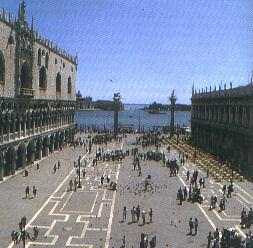
Commerce and tourism have always been part on the Piazza San Marco. Nothing new about that. Foreign traders gathered always there and travellers fell already a long time ago under its charm. In 1751, John Moore, an English visitor described the melt pot he saw when dusk fell on the piazza: "a mixture of Jews, Turks and Christians, lawyers, crooks and pick pockets, charlatans, old women and physicians, upper class masked ladies, lower class unmasked hookers, a tangle of senators, citizens, bourgeois, gondoliers and people of all kinds of character and occupations." Foreign traders gathered always there and travellers fell already a long time ago under its charm. In 1751, John Moore, an English visitor described the melt pot he saw when dusk fell on the piazza: "a mixture of Jews, Turks and Christians, lawyers, crooks and pick pockets, charlatans, old women and physicians, upper class masked ladies, lower class unmasked hookers, a tangle of senators, citizens, bourgeois, gondoliers and people of all kinds of character and occupations."
Moneylenders put up their stalls, ambulant merchants sold their wine and street performers showed their tricks, while the wealthy watched everything sitting on a terrace.
Today, the piazza is still buzzing with tourists, in whom portraitists mingle, souvenir sellers, pigeon food providers, promotion attractors from the Murano glass factories and multi-lingual guides. You don't need one: you have me :-):-).
Luckily there are still a few Venetians to drink a coffee at "Florian" (very expensive!), or to make an evening walk, the famous "passeggiata". The whole day, piazza San Marco witness a constant and amusing activity. It's alone in wintertime, when fog enters the laguna and the water rises sometimes so high that the piazza is flooded, that the place looks melancholic.
 |
|
Piazzetta |
Let's enter it now from the laguna side. This area, called PIAZZETTA, flanked by the Palazzo Ducale and the Libreria Sansovina used to be a harbour. It was filled up in the 12th century and on the "Molo" (waterside) two high red with grey granite columns, captured in the Orient, were erected. On one column stands the winged lion of the evangelist San Marco and the other shows the statue of Saint Theodorus, former patron of the city, with a shield and a dragon slain under his foot. This is a modern copy, the original is displayed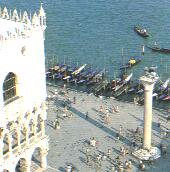 inside the Doges Palace. A third column fell into the laguna and was never found again. It is said that a certain, Nicolo Barattieri, who succeeded to place the two columns, was rewarded by gaining the sole monopoly of games at the condition that games were played between the two columns. inside the Doges Palace. A third column fell into the laguna and was never found again. It is said that a certain, Nicolo Barattieri, who succeeded to place the two columns, was rewarded by gaining the sole monopoly of games at the condition that games were played between the two columns.
The Piazzetta was also the place were public executions were performed until 1735. I read a book from the English writer Thomas Coryat, where he describes the stench of the heads of enemies and traitors, which were on display for three days and nights on the Piazzetta. Even today, most Venetians refuse to pass between the two columns because of the old curse of capital executions.
 |
|
Logetta |
A few more words about the LOGGETTA, this elegant marble construction at the foot of the Campanile, which collapsed on the Loggetta in 1902. Originally it was designed by Sansovino in the form of a triumphal arch, built as a "Ridotto dei Nobili" (meeting place of nobility). In 1659 it became a waiting room for the "Arsenalotti"(workforce of the Arsenal) and in the 18th century as the main siege of the city's lottery. After its reconstruction in 1902 it was richly decorated with reliefs, bronze allegoric images of Sansovino, representing some virtues. Normally you will see a queue of tourists waiting at the Loggetta to take the elevator up to the clock room and top of the Campanile.
Juts before starting next article about Basilica and the Doges palace, look left of the piazza when you are in front of the Basilica: the "PROCURATIE VECCHIE are 16th century buildings used by the attorneys, the procurators, highest judicial power of the Republic after the Doge.
To counterbalance, the "PROCURATIE NUOVE" were built in the 17th century.
Bibliography
Observations of Venice, by Thomas Coryat, The Companion guide to Venice, by Hugh Honour-Venice and its lagoon, by Giulio Lorenzetti, Venice-A thousand Years of Culture and Civilisation, by Peter Lauritzen-Heures Italiennes, by Henry James (La difference 1985)-The World of Venice, by Jan Morris.
|