Site Home - What's New? Feedback - About Jack- Travel/Art Links

Venice
|
Site Home - What's New? Feedback - About Jack- Travel/Art Links |
|
|
|
Venice |
|
Venice-Basilica San Marco-A vast and warty bug taking a meditative walk |
||
|
Before I continue about the Basilica here a few sentences of the very satiric and not always gentle Mark Twain and John Ruskin, one of the few who didn't appreciate San Marco. Not everybody does, tastes are impredictible, but it is interesting to know what these men had to write about th Basilica: I quote Mark Twain: "Its hoary traditions make it an object of absorbing interest to even the most careless stranger, and thus far it had interest for me; but not further. I could not go into ecstasies over its coarse mosaics, its unlovely Byzantine architecture, or its five hundred curious interior columns from as many distant quarries. Everything was worn out--every block of stone was smooth and almost 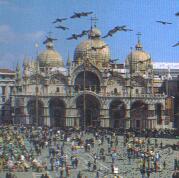 shapeless with the polishing hands and shoulders of loungers who devoutly idled here in bygone centuries and have died and gone to the dev--no, simply died, I mean. It was a vast and warty bug taking a meditative walk". (The Innocents Abroad, 1850) (unquote) shapeless with the polishing hands and shoulders of loungers who devoutly idled here in bygone centuries and have died and gone to the dev--no, simply died, I mean. It was a vast and warty bug taking a meditative walk". (The Innocents Abroad, 1850) (unquote)A bug with 2,463 paws, I must say, because this is the number of the porphyry, marble and granite columns that support the edifice! And Ruskin (I quote): "the crests of the arches break into a marble foam, and toss themselves far into the blue sky in flashes and wreaths of sculpted spray"(The Stones of Venice).(unquote) But let's get serious. "The Basilica San Marco was built in the form of a Greek cross. It was the trend and the code of construction of Christian edifices at that time. In the 11th century, the five cupolas (one in the centre and the other above each wing) are surelevated and mounted with golden crosses. The brick walls are covered with the finest marble and 4,000 square metres of surface are decorated by mosaics, of which certain are signed: Ucello, Tiziano, Tintoretto, Veronese.....Gothic sculpture will also enhance the façade but despite all that the 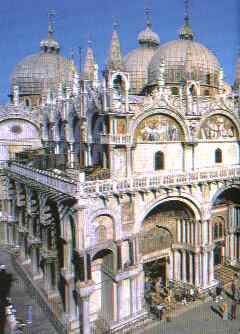 formidable impression of a Byzantine church is always present. The famous silhouettes-grandeur nature-of the four horses that the Venetians brought (?) with them, returning from Constantinople in 1204, still throne on the galley, just above the entrance portals. Notice the right side of the façade, next the Doges palace, a sculpted group in red porphyry (4th century). These 4 embracing personages known as the TETRARCAS and are supposed to be the emperors Diocletanius, Maximilianus, Valerianus and Constantius. formidable impression of a Byzantine church is always present. The famous silhouettes-grandeur nature-of the four horses that the Venetians brought (?) with them, returning from Constantinople in 1204, still throne on the galley, just above the entrance portals. Notice the right side of the façade, next the Doges palace, a sculpted group in red porphyry (4th century). These 4 embracing personages known as the TETRARCAS and are supposed to be the emperors Diocletanius, Maximilianus, Valerianus and Constantius. Looking at the basilica from the outside it is like an immense sculpture and painting gallery. That's why I bug you each time to visit this façade and anything else in the Basilica in fractioned time schedules. Let's start to admire the church from the OUTSIDE. The five surelevated cupolas I described already surmount five big portals, richly decorated with mosaics and sculptures. They merit your special attention. The only mosaic belonging to the original façade decoration of the church is above the first arch on the left: "Bringing of the corpse of St.Marco into the church" (1260-1270). You must be lucky to be there when there are no scaffolds in front of it, which is often the case! Then you will be able to see how the Basilica looked in the 13th century. It shows already that the famous bronze horses were already in pace. Above the central portal, sculptures showing us the traditional Venetian professions, the portal with the lion's head dates from the 11th and is inspired by Byzantine architecture. And the sculpted "pilasters from Akko", in front of the door of the Baptisterium never came from Akko but were part of the lute the crusades "rented" from a Constantinople church and brought with them in 1204. |
||