Site Home - What's New? Feedback - About Jack- Travel/Art Links

Venice
|
Site Home - What's New? Feedback - About Jack- Travel/Art Links |
|
|
|
Venice |
|
Venice-Doges Palace-History and begin visit |
||||
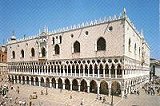 The Palazzo Ducale, better known as the Doges palace: "The whole history of Venice, its brilliant, stately past simmers and shines around you in a superb sea light!", wrote Henry James in "Italian hours, 1899, when he visited this monument. The Palazzo Ducale, better known as the Doges palace: "The whole history of Venice, its brilliant, stately past simmers and shines around you in a superb sea light!", wrote Henry James in "Italian hours, 1899, when he visited this monument. What a better symbol could illustrate the Venetian power and glory as this palace? It's a sumptuous chateau and not a citadel, build to protect and defend -like in Rome- the siege of the public institutions. It's here that the Doge lived and that the city council and tribunal had their offices. Centre of all power! Since this building is the most popular after the basilica, visit early in the morning or at lunchtime, to avoid the huge 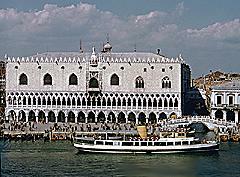 crowds. crowds.Venice was persuaded that no enemy could ever penetrate in its lagoon and threaten the Great Council. That even no citizen, in its wildest dreams, would have the nerve to oppose the authority. The Doges palace is certainly the best example of civil architecture in gothic style, usually reserved for churches. Like its neighbour, the basilica, it's the third edifice built on the same site. The first one (9th century) was a genuine fortified castle with a drawbridge, of which nothing is left. The actual palace, started in 1345, was to offer a luxurious and impressive home the high magistracy of Venice and its maritime empire. The Doges, judges, high ranked officials lived there and even a prison was part of the building. After two big fires (1574and 1577), the Doges palace was rebuilt by Andrea Palladio in the old gothic style. The decoration is posterior to the 16th century. The palace has two facades: one looking out on the lagoon, the other on the Piazetta. The facades have this incredible light and airy qualities we often see in Venice. The interior, with its enormous, decorated rooms, monumental paintings miss that quality. Don't forget also that all furniture was destroyed by the two fires and Napoleon.
We enter through the gothic entrance of the PORTA DELLA CARTA (1438-1442) where the Doge used to post his decrees and execution schedules. The richly decorated portal was made by Bartlomoeo and Giovanni Bon for the doge Foscari, doge you can see above the entrance, kneeling in front of the Lion of San Marco. It is part of the copy of a marble group from the 19th century of which the original was destroyed by Napoleon. Passing now in a sort of genuine triumphal arch bordered with statues, called Foscari arch, we see first a staircase, the Scala dei Giganti (Neptunus and Mars), whose gigantic statues are to see at the end of the staircase). But continuing the arched corridor, we arrive in a vast Renaissance style interior courtyard with two bronze wells. It used to be a place for people to get water or sit in the shadow. Today, important exhibitions are held here. To visit the private apartments and the
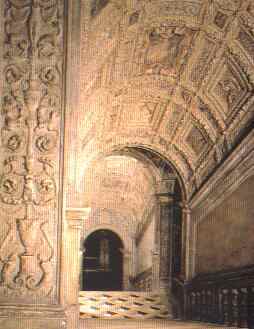
SCALA D'ORO, you will to have patience for my next articles. |
||||