|
After the Sala della Bussola,
here is the SALA D'ARMI (weapons room). A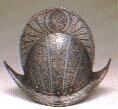 large and interesting weapons collection is on display and the ancient techniques how to eviscerate your enemies. Charming techniques!! The main object is the harness of Henri IV of France, who donated it to the city in 1603. And don't miss the superb iron chastity belt, verso, recto..... large and interesting weapons collection is on display and the ancient techniques how to eviscerate your enemies. Charming techniques!! The main object is the harness of Henri IV of France, who donated it to the city in 1603. And don't miss the superb iron chastity belt, verso, recto.....
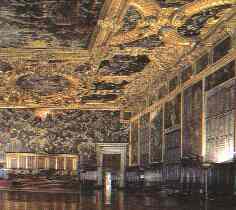 Finally we arrive in the vastest and impressive room (50 meters long) of the Doges palace: the SALA DEL MAGGIORE CONSIGLIO, dominating the laguna. More than 3,000 guests were present when a banquet was organized in 1574 for the visit of Henri III. Notice that it was in this room that a 480 members committee elected the Doge and its government by the Maggior Consiglio. All sessions of this government (which counted 1700 members at a certain time) were held. The room and other Renaissance treasures were destroyed by a fire in 1577 but were rebuilt with even more luxury and wealth. The greatest artists of that time collaborated like Palma, Tintoretto, Veronese, Bassano...... Finally we arrive in the vastest and impressive room (50 meters long) of the Doges palace: the SALA DEL MAGGIORE CONSIGLIO, dominating the laguna. More than 3,000 guests were present when a banquet was organized in 1574 for the visit of Henri III. Notice that it was in this room that a 480 members committee elected the Doge and its government by the Maggior Consiglio. All sessions of this government (which counted 1700 members at a certain time) were held. The room and other Renaissance treasures were destroyed by a fire in 1577 but were rebuilt with even more luxury and wealth. The greatest artists of that time collaborated like Palma, Tintoretto, Veronese, Bassano......
But what will attract your attention is the monumental eastern wall painting of "Paradise" by Tintoretto (22m-7m), inspired by Dante. Consider it as one of the largest paintings of an ancient master in the world with more than hundred personages! The wooden and gilded ceiling is sculpted with panels. Notice also Veronese's "Triumph of Venice", typical with its dramatic perspective. The frieze with portraits all around the room are those of 76 doges reigning from 804 to 1554 with one exception! It's the space with a black veil destined for Martin
 Falier, the doge executed in 1355 for treason. Falier, the doge executed in 1355 for treason.
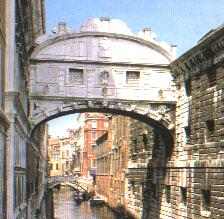
Time now for the poor convicted and prisoners! The palace was designed in such a way that the prisoners could be send from the council rooms to the prisons over the PONTE DEI SOSPIRI (Bridge of Sighs). The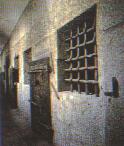 worst dungeons were the "pozzi" (pits)---dark, humid and infested by rats----. Minor law offenders were put in the "piombi"(lead rooms), where Casanova planned its spectacular evasion. If we believe what he wrote in his memories, "the prison was a healthy place, with enough food, comfortable beds, clothes and clean linen whenever it was necessary. And as you probably all know, the Bridge of Sighs was surnamed like that because of the heart tearing sighs that sounded when prisoners crossed the bridge for execution, long life imprisonment or for a nice torture session. But since this bridge was only built in 1600, it seems unlikely because the circumstances of prisons had improved a lot at that time in Europe, and this part of the Doges palace was reserved for small time criminals.
There should be a special tour, called "Itinerari Segreti" (secret itineraries), if you ant to see parts of the palace usually closed for the public. Like the chancellery, the questioning rooms, the torture chambers and the "piombi". It's a 90 min tour and very informative, but unfortunately, alas!, only in Italian.
Bibliography
Observations of Venice, by Thomas Coryat, A thousand Years of Culture and Civilisation, by Peter Lauritzen-Heures Italiennes, by Henry James (La difference 1985)-A. Tenenti, Piracy and the Decline of Venice (1967)-O. Logan, Culture and Society in Venice (1972) -M. Tafuri, Venice and the Renaissance (1989)-J. Pemble, Venice rediscovered (1995).
|