|
|
Sala Quattro Porte |
Like in many Italian palaces, the ground floor of the Palazzo Ducale
was used for different daily functions. used for different daily functions.
The first floor housed the residence of the Doge. But to get up there, take the luxurious and richly
decorated SCALA D'ORO. This staircase, work of the architect Andrea Gritti, copying a design from Jacopo Sansovino, was built between 1538
and 1559. It takes its name from the gilded stucco. Unfortunately, you can only visit the private apartments of the Doge, when there is a
temporary exhibition. The most interesting rooms are the "SALA DEGLI SCARLATTI", with an original, gilded, wooden ceiling, a sculpted open
fire from Antonio and Tulio Lombardo, and an elegant, marble relief from Petro Lombardo above the doors. The "SALA DELLE QUATTRO PORTE"
takes its name from the four Palladian portals. The white and gilded stucco of the ceiling is decorated with Tintoretto paintings, and you
can see a fresco on the wall, probably from Veronese. Now comes the famous waiting room for ambassadors and dignitaries, the
"ANTICOLLEGIO", designed by Palladio, where a lot of the most beautiful paintings of the palace are assembled. Four mythological
tableaux from Tintoretto and ceiling frescoes from Veronese. Notice the splendid "Kidnapping of Europe" of a remarkable luminosity, to seeon the wall opposite the windows (Veronese).
Now the "SALA DEL COLLEGIO". It's under a magnificent ceiling, Veronese again, (Justice and peace offer a sword and scale to the
Doge), that that the Doge and counsellors,
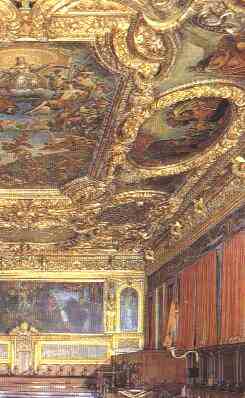 |
| Sala del Senato |
received foreign ambassadors or listened to
the reports of the Venetian diplomats when they returned from their missions. Again, the ceiling is one of the
master works in this room. Allegoric figures painted by Veronese on several panels, "Victory in Lepanthus" a painting by the same
Veronese.
Now the "SALA DEL SENATO". Here the Doges met with senate members (Pregadi), to discuss interior and foreign policy. Decoration is the
triumph of baroque style: "Triumph of Venice "on the ceiling by Tintoretto, surrounded by the Greek gods on the Olympus mountain. I
don't think you can beat the pomposity and decorative excess. Next
room is the SALA DEL CONSIGLIO DEI DIECI. A council of 10 members (Consiglio dei Dieci) was created in 1310 after a
conspiracy was discovered. This group repressed the plot and from temporary became a
permanent security committee. Art works here are again ceiling paintings from Veronese.
Now we come in the SALA DEL BUSSOLA, which was the waiting room for the suspected witness who had to answer the security council's
questions. A lions mouth (bocca di leone) at the door was used as a secret complaint box. pomposity and decorative excess. Next
room is the SALA DEL CONSIGLIO DEI DIECI. A council of 10 members (Consiglio dei Dieci) was created in 1310 after a
conspiracy was discovered. This group repressed the plot and from temporary became a
permanent security committee. Art works here are again ceiling paintings from Veronese.
Now we come in the SALA DEL BUSSOLA, which was the waiting room for the suspected witness who had to answer the security council's
questions. A lions mouth (bocca di leone) at the door was used as a secret complaint box.
Still to go: Sala d'Armi, Sala del Maggior Consiglio, the prisons (prigioni), ponte dei Sospiri and the secret
corridors (itinerary segreti). But that's for next article.
Bibliography
Observations of Venice, by Thomas Coryat, A thousand Years of Culture and Civilisation, by Peter
Lauritzen-Heures Italiennes, by Henry James (La difference 1985)-A. Tenenti, Piracy and the Decline of Venice(1967)-O. Logan, Culture and Society in Venice (1972) -M. Tafuri,
Venice and the Renaissance (1989)-J. Pemble, Venice rediscovered(1995).
|