|
 In
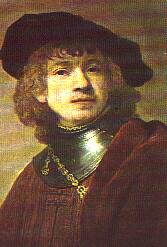
1639 Rembrandt van Rijn, who was born in Leyde, bought the red-shuttered house
at 4-6 Jodenbreestraat. He was by then an established painter, living already
since 9 years in Amsterdam, and had further secured his creature comforts by
marrying 5 years ago a wealthy heiress, Saskia van Uylenburgh. I figure things
haven’t changed since about money marriages. It would be the most prolific 21 years of his existence (1639-1660). The
orders are coming in and it is the year when he paints the famous “Night
watch”. ;-). As he settled in the middle of a Jewish quarter it provided him
with many of his models, especially when he was painting the biblical themes he
loved. It was really not usual at those times to go and live among Jews. His
neighbors are his friends: the scientist Menasse ben Israel, the rabbi of
Amsterdam, Ephraim Bueno, a Jewish Portuguese physician and Jan Lutma, a wealthy
jeweler. Saskia and Rembrandt lived on the ground floor, in the back room. The
atelier was on the first floor. It’s here that his son Titus was born (1641)
and Saskia died in 1642. From now on he falls on hard times and his work is no
longer fashionable. He is declared bankrupt in 1656 and the house sold.
Rembrandt moves out of the Jewish quarter and in 1660 settles down in the
Jordaan area (then a very poor quarter). In
1639 Rembrandt van Rijn, who was born in Leyde, bought the red-shuttered house
at 4-6 Jodenbreestraat. He was by then an established painter, living already
since 9 years in Amsterdam, and had further secured his creature comforts by
marrying 5 years ago a wealthy heiress, Saskia van Uylenburgh. I figure things
haven’t changed since about money marriages. It would be the most prolific 21 years of his existence (1639-1660). The
orders are coming in and it is the year when he paints the famous “Night
watch”. ;-). As he settled in the middle of a Jewish quarter it provided him
with many of his models, especially when he was painting the biblical themes he
loved. It was really not usual at those times to go and live among Jews. His
neighbors are his friends: the scientist Menasse ben Israel, the rabbi of
Amsterdam, Ephraim Bueno, a Jewish Portuguese physician and Jan Lutma, a wealthy
jeweler. Saskia and Rembrandt lived on the ground floor, in the back room. The
atelier was on the first floor. It’s here that his son Titus was born (1641)
and Saskia died in 1642. From now on he falls on hard times and his work is no
longer fashionable. He is declared bankrupt in 1656 and the house sold.
Rembrandt moves out of the Jewish quarter and in 1660 settles down in the
Jordaan area (then a very poor quarter).
The Rembrandt house is now a museum, with 250 of his etchings on show—too many
to take in at one gulp. But not one Rembrandt painting, don’t get any
illusions.
Turn left as you come out of the Rembrandt house and then right into
Waterlooplein. The flat area on the banks of the river Amstel is an artificial
island, raised above flood-level from a swampy sandbank in the late 16th
century. The first Jewish Sepharad immigrants from Portugal began to settle
here. They could afford to build salubrious homes overlooking the Amstel. The
later poorer Ashkenazi from the east crammed into rookeries island, and the
district became densely populated, a three dimensional labyrinth of alleys and
tenements. It was not until the late 19th century that the district
took a turn for the better. In the post war years the Jewish quarter was a ghost
town in every sense of the word. Of its 120,000 people, only 8,000 survived the
nazi pogroms and deportations.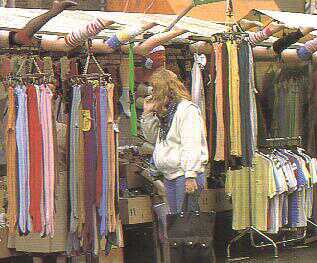
The daily market held here, though colourful enough, is a mere shadow of the
original flea market. Its clutter of stalls, selling neo-hippie gear, cheap
jewellery, junk, old clothes and perhaps the occasional original antique is
duplicated in similar markets all over Europe.
The complex of modern buildings which occupies the site between the
Waterlooplein and the river Amstel is the “Muziektheater”. Familiarly known
as the “Stopera”, it houses the National Ballet, the Netherlands Dance
Theatre, the Netherlands Opera and the new Stadhuis (Town Hall). There are cafes
and restaurants within the complex and is not a bad place for refreshment on a
winter or spring day, when the Waterlooplein can be chilly and windswept.
We come now to the Jonas Daniel Meijer plein separating the grand Portuguese
synagogue from the Jewish Historical Museum. In the middle, under the tress, a
bronze statue, the “Dokwerker” (the dock labourer) reminding us that the
dock labourers of Amsterdam’s port were the first to go on general strike to
protest against the first raids on Jews by the nazis. 22th of February 1941: the
Germans assemble the Jews on this square to arrest and deport them. The
docker’s strike was followed by a solidarity movement by Amsterdam’s
population. But the strike was soon tamed in blood and tears.
Bibliography
Holland,
by Adam Hopkins (Faber and Faber, 1988), Penguin Guide to Amsterdam (ed.Vincent
Westzaan, Penguin 1990), Guide du Routard 1998 (ed.Hachette), -Dwalen door
Amsterdam en reizen door de Benelux, ( ed. Lekturama 1984),
“The Embarrassment of Riches”, by Simon Schama (Collins 1987), “De
Jodenbuurt over de eeuwen” by J.Hofkens (Lannoo 1995).
|